The debate between fabric and vinyl for exhibition graphics has effectively been settled by the industry fabric has become the default for most exhibition applications, and for good reasons. But vinyl still has its place, and there are scenarios where it remains the better choice. Understanding the practical differences helps you specify the right material for each element of your exhibition presence.
We produce both fabric and vinyl exhibition graphics and can advise on which material suits each application within your stand design.
Key takeaways
- Dye-sublimation printed fabric is the standard for backdrops, tension frames, hanging banners and portable display systems due to its lightweight portability, crease recovery and glare-free appearance
- Vinyl (PVC banner and self-adhesive) remains the better choice for outdoor event graphics, surface-applied graphics, wet environments and applications requiring rigid mounting
- Fabric weighs 70-80% less than equivalent PVC graphics, dramatically reducing transport costs and making hand-carry setup practical for multi-show exhibitors
- Fabric graphics are machine-washable and reusable across multiple events; vinyl graphics degrade with folding and typically last fewer shows
- Vinyl produces sharper fine detail and richer blacks than fabric at close viewing distances relevant for product photography and technical diagrams
- The material choice may be determined by the hardware system rather than preference tension frames require SEG fabric, roller banners require specific face films
Fabric: How It Works and Where It Excels
Exhibition fabric graphics are produced using dye-sublimation printing. The artwork is printed onto transfer paper using sublimation inks, then heat-pressed against polyester fabric at approximately 200°C. The heat converts the ink to a gas that penetrates the polyester fibres and solidifies within them. The result is a printed graphic that is structurally part of the fabric the ink cannot crack, peel, scratch or flake off because it is inside the fibre, not on the surface.
Standard exhibition fabric weights range from 180gsm (lightweight flag fabric for hanging banners) to 260gsm (standard display fabric for backdrops and tension frames). Blockout fabric (approximately 300gsm) contains an opaque interlayer for double-sided applications where light transmission would cause ghosting. Backlit fabric (approximately 200gsm) is engineered for even light transmission in lightbox displays.
The practical advantages for exhibition use are significant. A 3-metre by 2.5-metre fabric backdrop weighs under 2kg and folds into a bag the size of a laptop case. The equivalent PVC banner weighs 6-8kg and must be rolled onto a core to prevent permanent crease damage. At the end of a three-day show, a fabric graphic can be folded loosely into a suitcase; a PVC banner needs a carry tube.
Fabric recovers from creasing naturally hanging a folded fabric graphic on its frame for an hour before the show opens is usually sufficient for creases to drop out. Stubborn creases can be removed with a handheld steamer. PVC creases are permanent once set and cannot be removed without risking damage to the print surface.
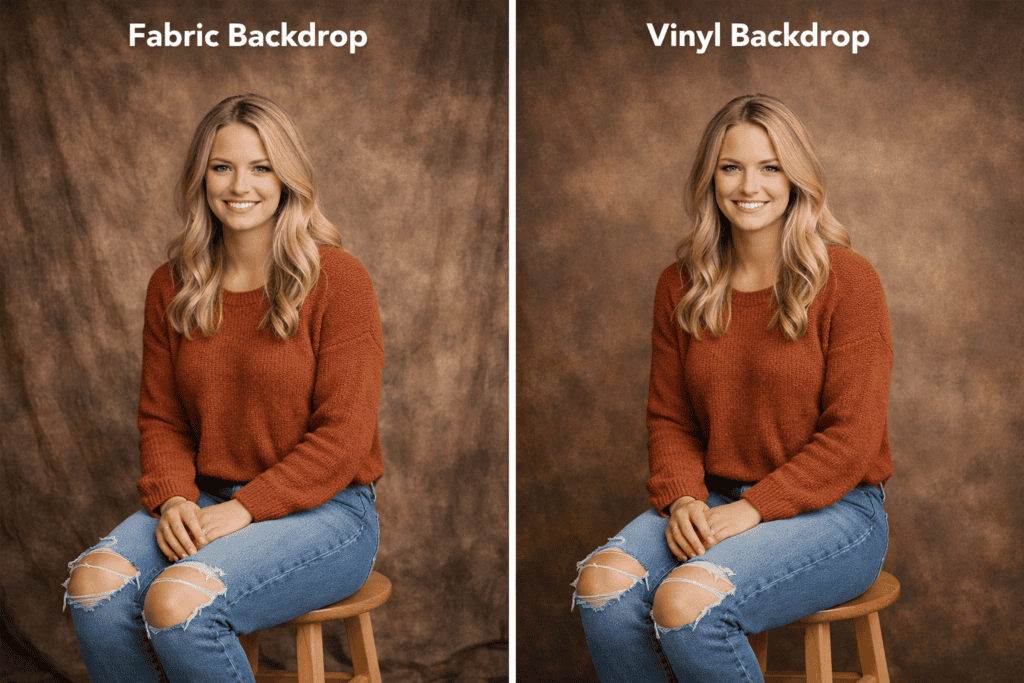
Under exhibition hall lighting (typically high-intensity fluorescent or LED arrays), fabric produces a soft, non-reflective surface that is readable from any angle. PVC catches the overhead lights and creates glare hotspots that obscure the graphic content from certain viewing angles. For a stand positioned under direct overhead lighting, this difference is immediately visible and fabric is clearly preferable.
Vinyl: Where It Still Wins
Despite fabric’s dominance in exhibition display, vinyl retains clear advantages in specific applications.
Outdoor events. Standard exhibition fabric is not waterproof. A sudden rain shower at an outdoor show will soak through fabric graphics and leave them dripping. PVC banner is inherently waterproof and is the correct choice for any outdoor or partially covered application. Mesh PVC is used for large-scale outdoor event branding where wind loading is a consideration.
Surface-applied graphics. Self-adhesive vinyl is the only option for graphics applied directly to walls, floors, windows, counters, vehicles and furniture. Fabric cannot be adhesive-applied. If your exhibition presence includes floor graphics, window manifestations, counter wraps or vehicle livery, these elements must be vinyl. For guidance on the range of vinyl types available, see our substrates guide.
Fine detail and photographic sharpness. Vinyl produces sharper fine detail than fabric at close viewing distances. The smooth, non-textured surface of glossy or satin vinyl resolves fine lines, small text and photographic detail more crisply than the woven texture of polyester fabric. For exhibition panels displaying product photography, technical diagrams, fine text or QR codes intended for scanning at arm’s length, vinyl delivers better results.
Colour density and black reproduction. Vinyl particularly solvent-printed vinyl produces denser blacks and more saturated colours than dye-sublimation fabric. The difference is most noticeable in images with deep shadow areas, dark backgrounds and high-contrast compositions. If colour density is critical to the visual impact, vinyl is the stronger performer.
Weight, Transport and Cost Comparison
The weight difference between fabric and PVC compounds across multiple graphic elements. A typical 3×3-metre custom-build stand might include a 3m x 2.5m backdrop, two 1m x 2.5m side panels, a counter graphic, a hanging banner and two roller banners. In fabric, the graphic package weighs approximately 8-10kg total and fits in a single large suitcase or two holdalls. In PVC, the same package weighs 25-35kg and requires a wheeled flight case and two banner tubes.
For exhibitors attending multiple shows per year, or shipping graphics internationally, the weight difference translates directly into lower transport costs. Air freight for exhibition graphics is charged by volumetric weight a compact fabric package costs a fraction of an equivalent PVC shipment.
Production costs are broadly similar between fabric and vinyl for standard exhibition graphics. Fabric has a slightly higher material cost but requires no lamination (the sublimated ink is inherently durable), which partially offsets the difference. The lifecycle cost favours fabric because it survives more shows a well-maintained fabric graphic can be used 20-30 times, while a PVC graphic typically shows wear after 8-12 shows.
Hardware Compatibility
The display hardware often determines the material choice. Tension fabric displays (SEG frames) require fabric with a silicone edge sewn around the perimeter vinyl cannot be used. Pop-up displays accept both fabric skins and vinyl panels depending on the manufacturer and model. Roller banners use specific face films (usually a specialist PVC or polyester film) designed for the tensioning mechanism standard fabric is too thick and too flexible for most roller mechanisms.
If you are investing in new display hardware, choosing a fabric-compatible system gives you the flexibility to use the material that dominates current exhibition practice. If you already own hardware designed for vinyl panels, there is no reason to replace functional equipment solely to switch materials use vinyl with that hardware and consider fabric when the hardware reaches the end of its life.
Maintenance and Lifespan
Fabric graphics can be machine-washed at 30°C on a gentle cycle, air-dried and reused. This is genuinely useful after a busy show where the graphic has accumulated fingerprints, coffee splashes, scuffs and general show-floor grime. Washing restores the graphic to near-new condition.
Vinyl graphics cannot be machine-washed. Surface cleaning with a damp cloth removes surface dirt but cannot address scuffs, scratches or creasing that accumulate with handling and transport.
We recommend inspecting graphics after each show and budgeting for replacement when the graphic no longer meets brand presentation standards. For clients exhibiting more than four times per year, our warehousing service can store exhibition graphics between shows and manage the inspection, cleaning and replacement cycle.
If you need exhibition graphics produced, brief us on your next exhibition and we will recommend the right material for each element of your stand.
Frequently Asked Questions
Is fabric always better than vinyl for exhibitions?
No. Fabric is better for backdrops, tension frames and portable displays due to weight, portability and appearance under exhibition lighting. Vinyl is better for outdoor events, surface-applied graphics, fine photographic detail and applications requiring waterproof materials. Most stands use both materials across different elements.
Can I use fabric in a roller banner?
Most standard roller banners are designed for PVC or polyester film, not fabric. Some premium roller systems accept thin display fabrics, but the range is limited. If roller banners are a key part of your display, check hardware compatibility before specifying fabric.
How many shows will a fabric graphic last?
With proper care (folding loosely, storing in a protective bag, machine-washing between shows), a dye-sublimation fabric graphic can be used for 20-30 shows before colour fading or mechanical wear requires replacement. Actual lifespan depends on handling care and the intensity of use at each show.
Does fabric graphic printing cost more than vinyl?
Production costs are broadly similar. Fabric material is slightly more expensive per square metre but does not require lamination, which offsets much of the difference. The lifecycle cost favours fabric due to its greater durability and reusability across multiple events.
Can you print double-sided fabric banners?
Yes. Blockout fabric contains an opaque interlayer that prevents light transmission between the two faces. Each side is printed separately (or the fabric is printed on both sides using a double-pass sublimation process), producing a fully double-sided graphic with no ghosting.
What about sustainability is fabric or vinyl more environmentally friendly?
Polyester fabric is recyclable through textile recycling streams and the inks are water-based (no solvents). PVC is more difficult to recycle and solvent-based inks have higher VOC emissions during production. Fabric’s longer reuse lifespan also means fewer replacements over the same exhibition programme period. Neither material is perfect, but fabric has a lower environmental impact across its lifecycle.