Every large format print job starts with a decision that most people rush past: which substrate should we print on? It sounds like a production detail, but the material you choose affects colour vibrancy, durability, weight, installation method, fire rating, environmental credentials and cost. Get it wrong and you end up with graphics that curl off walls, fade within weeks or fail a building inspector’s visit.
As a large format printing services provider working across retail, construction, corporate and event environments, we print on dozens of different substrates every week. This guide covers the ones that matter most, when to use each, and the trade-offs involved.
Key takeaways
- Substrate choice directly affects print quality, durability, installation method and total project cost
- Self-adhesive vinyl is the most versatile substrate for interior and exterior graphics, available in dozens of specialist variants
- Fabric substrates are increasingly replacing PVC for exhibition and interior display work due to their lightweight portability and crease-recovery properties
- Rigid substrates like foamex, dibond and corrugated board are used for freestanding displays, hoarding panels and semi-permanent signage
- Fire rating certification (B1 or Class 0) is mandatory for most public-facing interior installations in the UK
- Choosing the wrong substrate is one of the most common causes of print project failure and the easiest to prevent
Self-Adhesive Vinyl: The Workhorse of Large Format
Self-adhesive vinyl accounts for more large format print output than any other material. It consists of a printed face film bonded to a pressure-sensitive adhesive layer on a silicone release liner. The range of vinyl types available is vast, and selecting the right one depends on application surface, expected lifespan, indoor or outdoor use, and whether the graphics will need to be removed later.
Monomeric vinyl is the most economical option, suitable for flat interior surfaces and short-term promotions lasting up to two years. It tends to shrink slightly over time, which rules it out for vehicle wraps or curved surfaces. Polymeric vinyl offers better dimensional stability and a lifespan of five to seven years, making it the standard choice for most commercial interior graphics, retail wall displays and window applications.
Cast vinyl sits at the premium end. Manufactured by casting liquid PVC onto a release liner rather than pressing it through rollers, cast films are thinner (typically 50 microns versus 80-100 microns for polymeric), more conformable around curves and rivets, and rated for up to ten years outdoors. Vehicle wraps, fleet graphics and complex architectural surfaces demand cast vinyl.
Specialist variants include etched glass film for privacy glazing, one-way vision (perforated) vinyl for window graphics that maintain outward visibility, anti-graffiti laminates for public-facing installations, and floor graphics vinyl with integrated R-rated slip-resistant laminate for retail and event environments.
Fabric and Textile Substrates
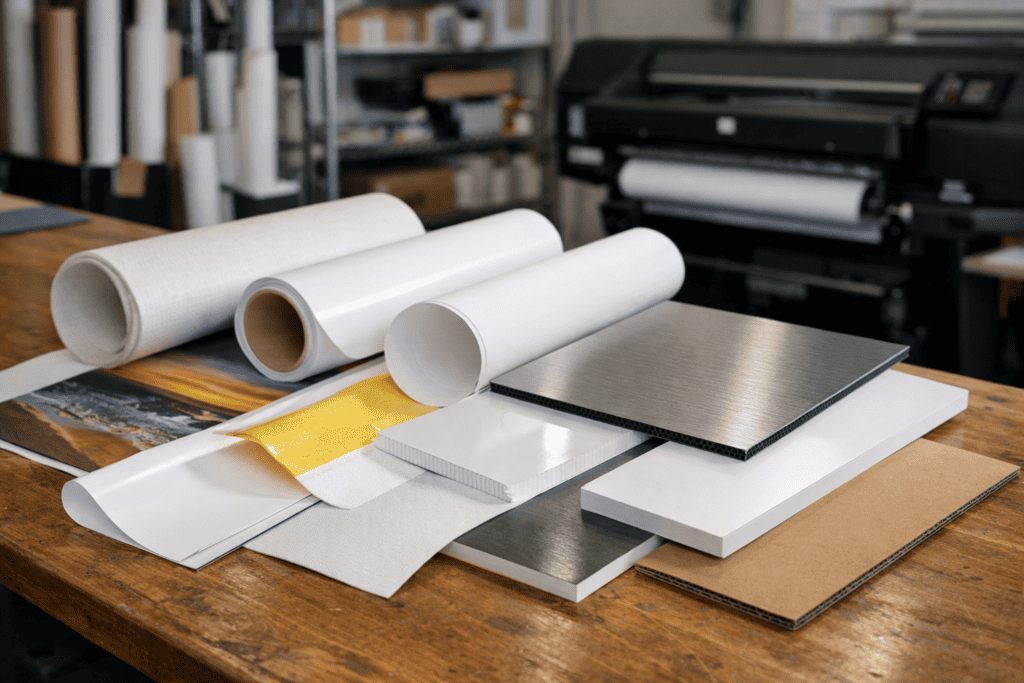
Fabric printing has transformed the exhibition and event graphics sector over the past decade. Dye-sublimation printed polyester fabric is now the default choice for exhibition backdrops, tension frame displays, hanging banners and lightbox graphics. The reasons are practical: fabric is lightweight (typically 200-260gsm compared to 400gsm+ for PVC), it folds without creasing permanently, it can be machine-washed, and it eliminates the glare problems that PVC banners create under exhibition hall lighting.
Blockout fabric contains an opaque layer between two printable faces, making it suitable for double-sided hanging banners where light transmission would otherwise cause ghosting. Backlit fabric is engineered for the opposite purpose even light transmission through the material for use in lightbox frames and illuminated displays.
For interior wall applications, self-adhesive fabric wallcovering provides a premium textile finish without the weight and rigidity of traditional wallpaper. It is repositionable during installation, which is a significant advantage when covering large unbroken wall surfaces where air bubbles and alignment errors compound across the run.
Rigid Substrates: Foamex, Dibond, Corrugated Board and Acrylic
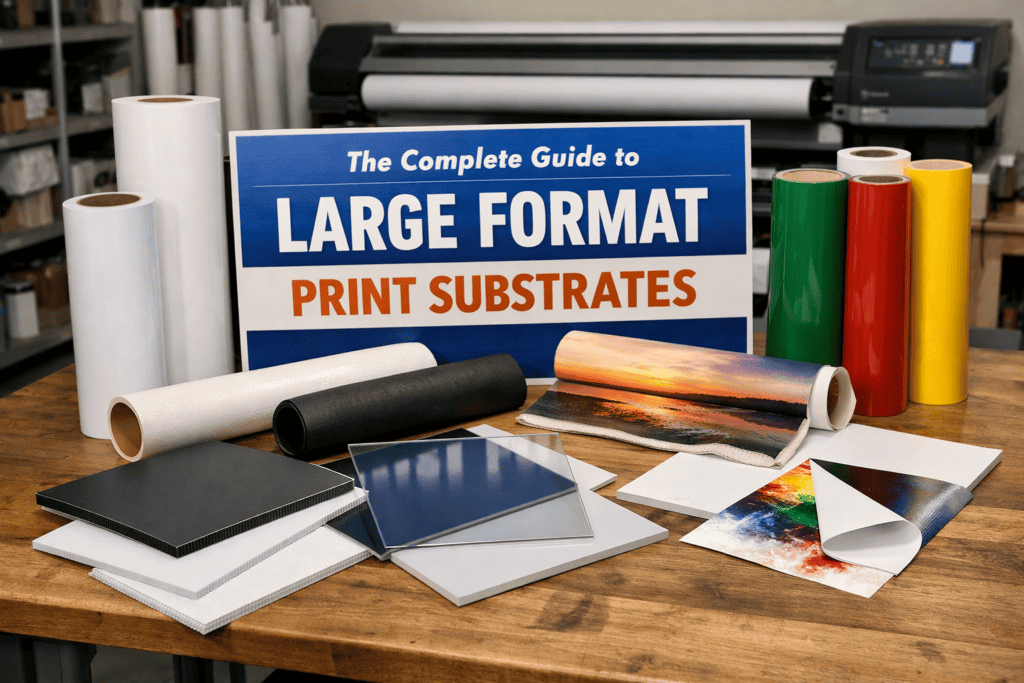
Rigid substrates are printed using UV flatbed technology, where the ink is cured by ultraviolet light directly onto the board surface. This produces vibrant, durable graphics without the need for a separate laminate layer.
Foamex (expanded PVC foam board) is the most commonly used rigid substrate in commercial print. Available in thicknesses from 1mm to 19mm, it is lightweight, easy to cut and drill, weather-resistant and printable on both sides. Standard applications include point-of-sale displays, exhibition panels, site signage, A-frames and wall-mounted displays. It is not the most visually refined material the surface has a slight texture but for cost-effective, versatile rigid print, it is hard to beat.
Dibond (aluminium composite panel) consists of two thin aluminium sheets bonded to a polyethylene core. It is rigid, flat, weatherproof and dimensionally stable, making it the standard for premium exterior signage, hoarding panels, wayfinding systems and architectural graphics. The aluminium surface accepts UV print well and can be finished with a protective laminate for additional scratch and UV resistance.
Corrugated board is the material of choice for temporary POS display production, packaging displays, and short-term promotional graphics. E-flute and B-flute corrugated boards print well on flatbed and can be die-cut into complex structural shapes for freestanding display units.
Acrylic (Perspex) is used for premium interior displays, illuminated signage panels and architectural features. It can be printed directly or reverse-printed on the back surface for a high-gloss, protected finish.
Mesh and Scrim: When Wind Load Matters
Standard PVC banners create significant wind loading when installed at height or across building facades. Mesh banners address this by incorporating thousands of tiny perforations across the material, allowing wind to pass through while maintaining a readable printed image from normal viewing distances.
Mesh is specified for building wraps, scaffolding banners, fence graphics and any large-scale exterior installation where wind loading could damage the graphics or the structure they are fixed to. The aperture ratio (percentage of open area) varies between products typically 30% to 50% and the choice depends on the balance required between wind permeability and image density.
Heavy-duty construction mesh (also called site mesh or debris netting) can also be printed, providing both safety screening and branded hoarding in a single material. This is increasingly common on major development sites where the client wants visual impact without the cost and structural requirements of solid hoarding panels.
Paper-Based Substrates for Interior Use
Paper substrates still have an important role in large format print, particularly for short-term interior applications. Coated poster papers deliver excellent colour reproduction at low cost and are used extensively for retail window displays, promotional posters and in-store graphics where the expected lifespan is days or weeks rather than months.
Photo papers (satin, gloss and lustre finishes) are used for photographic exhibition prints, gallery displays and high-end presentation graphics where image quality takes priority over durability. These papers are typically printed on aqueous inkjet systems rather than solvent or UV printers, as the water-based inks produce a wider colour gamut on photographic stock.
Self-adhesive paper stocks are used for wall graphics, labels and short-term floor decals in low-traffic environments. They are significantly cheaper than vinyl equivalents but offer reduced durability and water resistance.
Fire Ratings and Compliance: B1, Class 0 and BS 476
Any printed graphic installed in a public building, retail environment, hospitality venue or commercial interior must comply with fire safety regulations. In the UK, this typically means achieving a Class 0 rating (the highest classification for surface spread of flame under BS 476: Parts 6 and 7) or the European B1 classification under DIN 4102.
Most major vinyl and fabric substrates are available in fire-rated variants, but it is essential to verify this at specification stage rather than assuming compliance. The fire rating applies to the complete system substrate, ink and any laminate or adhesive not just the base material. A fire-rated vinyl printed with non-compliant ink and finished with a standard laminate may not meet the required standard.
We supply fire rating certificates with every applicable job. If your installation is subject to building control inspection or venue safety requirements, confirm the fire rating specification before production rather than after.
Colour Accuracy Across Different Substrates
The same print file will produce noticeably different colour results on different substrates. A warm grey printed on bright white coated vinyl will appear cooler on uncoated paper, warmer on fabric, and different again on foamex due to the slight yellow cast of the board surface.
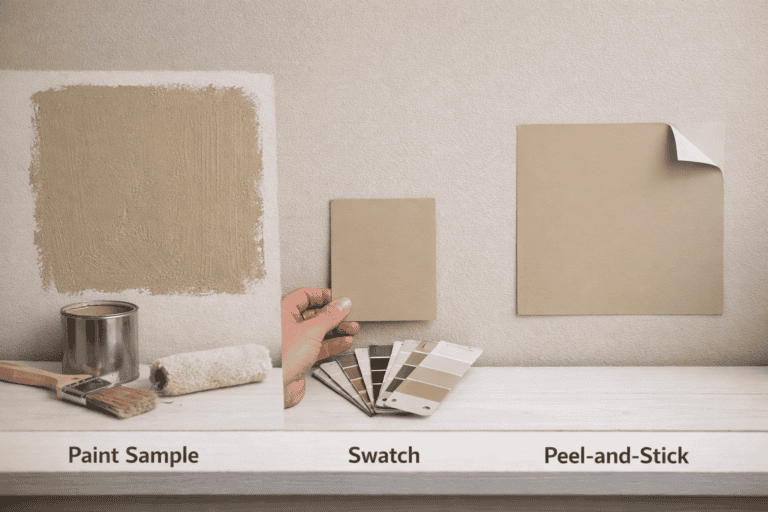
This is where colour management and ICC profiling becomes essential. We build and maintain custom ICC profiles for every substrate we print on, ensuring that the output is calibrated to the specific optical properties of each material. For colour-critical work particularly paint sampling, brand colour reproduction and photographic output we can provide spectrophotometer-verified proofs on the actual production substrate before committing to the full run.
If your project involves printing the same design across multiple substrates (for example, vinyl wall graphics alongside fabric banners and foamex display panels), discuss this at the briefing stage. We can adjust the colour profiles to achieve the closest visual match across the different materials.
How to Choose the Right Substrate for Your Project
Start with these five questions and the answer will usually narrow the options to one or two candidates:
Where will it be installed? Interior substrates do not need the UV resistance, waterproofing or wind-load ratings of exterior materials. Specifying exterior-grade materials for an indoor installation wastes money.
How long does it need to last? A two-week retail promotion does not need seven-year polymeric vinyl. Equally, a permanent wayfinding system should not be printed on economy monomeric film that will shrink and peel within eighteen months.
What surface is it being applied to? Textured walls, curved surfaces, glass, painted plaster, brickwork and metal all demand different adhesive types, face films and installation techniques.
Does it need a fire rating? If the installation is in any public-facing environment, the answer is almost certainly yes. Confirm the required standard before production.
What is the viewing distance? Graphics viewed from two metres need higher print resolution and finer detail than a hoarding panel viewed from twenty metres across a road. Viewing distance also influences substrate texture tolerance a slight foamex surface grain is invisible at five metres but noticeable at arm’s length.
If you are unsure about substrate selection, contact our production team with your project details and we will recommend the best option for your specific application, environment and budget.
Frequently Asked Questions
What is the most durable large format print substrate for outdoor use?
Cast vinyl with a UV-protective laminate offers the best combination of durability, colour retention and conformability for outdoor applications. Properly laminated cast vinyl graphics can last eight to ten years in UK weather conditions. For rigid outdoor applications, dibond (aluminium composite) is the most dimensionally stable and weather-resistant option.
Can fabric graphics be used outdoors?
Standard dye-sublimation printed polyester fabric is not waterproof and is not recommended for permanent outdoor installation. However, specialist outdoor fabric with water-resistant coatings is available for temporary event use and covered exterior locations. For anything exposed to sustained rain, PVC or mesh banners are more appropriate.
What fire rating do I need for graphics in a shopping centre?
Most UK shopping centres require Class 0 (BS 476: Parts 6 and 7) for any printed graphics, including wall vinyl, hanging banners, ceiling graphics and temporary promotional displays. Some centre management teams specify additional requirements. Always confirm with the centre management office before production.
What is the difference between monomeric, polymeric and cast vinyl?
The difference lies in manufacturing method, thickness, conformability, dimensional stability and expected lifespan. Monomeric vinyl is the most economical (one to two years), polymeric offers mid-range performance (five to seven years), and cast vinyl provides premium durability and flexibility (up to ten years). Each suits different applications there is no single “best” option across all scenarios.
How do I know which substrate to specify?
Tell your print provider where the graphics will be installed, what surface they are going onto, how long they need to last, whether a fire rating is required, and what the typical viewing distance will be. These five data points will narrow the substrate options to one or two clear recommendations. If budget is a constraint, mention this too there are often cost-effective alternatives that perform adequately for the intended lifespan.
Can you print on materials we supply?
In some cases, yes. We can print on customer-supplied substrates provided they are compatible with our print systems and we can verify the material specification. We would need a sample for testing before committing to production. For quality assurance and warranty reasons, we generally recommend printing on substrates sourced through our own tested and profiled supply chain.