You have produced the graphics, manufactured the signage, printed the POS displays and colour-matched the sampling collateral. Everything is sitting in production, ready to go. Now comes the part that most print buyers underestimate: getting all of it to the right places, at the right times, in the right condition. That is fulfilment and for multi-site campaigns, it is the difference between a smooth programme delivery and a logistical mess.
We provide warehousing and fulfilment as an integrated part of our production service. This guide explains how print fulfilment works, why it matters for multi-site campaigns, and what to look for when deciding whether to manage distribution in-house or through your print production partner.
Key takeaways
- Print fulfilment covers warehousing, kitting, pick-and-pack, labelling, distribution and inventory management for printed materials and display units
- For multi-site campaigns, fulfilment complexity scales faster than print complexity 200 sites means 200 individual deliveries with site-specific contents
- Kitting materials per site before dispatch reduces installation errors, eliminates on-site sorting and ensures every location receives exactly what it needs
- Integrated fulfilment (where your print producer also handles warehousing and distribution) removes the handoff between production and logistics that causes most delivery failures
- Buffer stock held in the warehouse enables rapid replacement of damaged or missing items without initiating a new production run
- Stock management systems that track inventory levels and trigger replenishment alerts prevent the most common fulfilment failure: running out of materials mid-programme
What Print Fulfilment Actually Involves
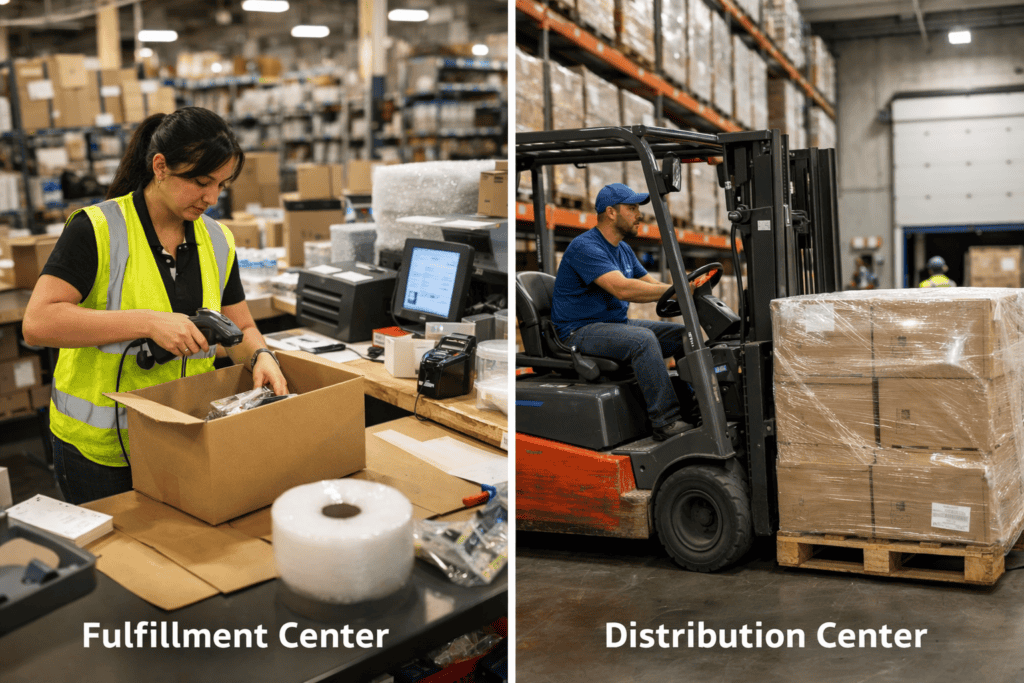
Fulfilment is an umbrella term covering every activity between production completion and materials arriving at their destination. For a simple single-site delivery, fulfilment is straightforward pack the items, book a courier, ship it. But for a multi-site rollout programme covering 50, 200 or 500 locations, fulfilment becomes a disciplined logistics operation with multiple sequential stages.
Goods-in and inspection: Finished materials are received into the warehouse from the production floor (or from external suppliers for items not produced in-house). Every item is checked against the production order quantity, print quality, finishing, dimensions before being accepted into stock.
Warehousing: Materials are stored in organised, labelled locations within the warehouse. Temperature and humidity are controlled where necessary (certain vinyl and paper stocks are sensitive to moisture). Inventory is tracked digitally so that stock levels are visible at any time.
Kitting: For multi-site programmes, materials are assembled into site-specific kits. Each kit contains exactly the items specified for that location the correct dimensions, the correct quantity, the correct variant packed in a labelled box with a contents list and installation instructions. This is the step that transforms a bulk production run into a managed deployment programme. For a deeper look at how this works, see our article on kitting for retail rollouts.
Pick and pack: For ongoing replenishment and ad-hoc orders (as opposed to bulk programme deployment), individual orders are picked from stock, packed for transit and labelled with the delivery address. This is the standard e-commerce fulfilment model applied to print materials.
Distribution: Kitted deliveries or individual orders are dispatched via courier, pallet network or dedicated transport depending on volume and urgency. Delivery is tracked and confirmed, with proof of delivery recorded for each consignment.
Why Integrated Fulfilment Matters
The traditional model for multi-site print campaigns involves a chain of separate suppliers: a design agency creates the artwork, a print company produces the materials, a warehousing company stores them, a logistics company distributes them, and an installation team fits them on site. Each handoff between suppliers introduces a communication gap, a potential point of failure, and an opportunity for things to go wrong.
Integrated fulfilment eliminates these handoffs by keeping production, warehousing and distribution under one roof and one management system. When the production run finishes, materials move directly into the adjacent warehouse. There is no transit damage, no miscounted pallets arriving at a third-party facility, and no mismatched documentation between what was produced and what was received.
The operational advantages compound on larger programmes. A quality issue discovered during kitting can be resolved with a reprint the same day because the production equipment is in the same building. A client change to a site specification can be incorporated into the next production batch and kitted into the correct delivery without disrupting the programme schedule. And a single programme manager controls the entire chain from production through to delivery confirmation.
Kitting: The Step That Makes Everything Else Work
Kitting is the process of assembling site-specific packs from the bulk production output. For a 200-site retail rollout, kitting means creating 200 individual boxes, each containing the exact items specified for that site based on its unique survey data the correct fascia graphic dimensions, the correct window vinyl sizes, the correct quantity of shelf-edge strips, plus installation guides, cleaning instructions and any site-specific notes.
The alternative shipping bulk materials to a regional hub and expecting on-site teams to sort, count and allocate is how installation errors happen. Wrong graphics at wrong stores, missing items, surplus stock piled up in corridors, and installation teams spending an hour per site working out what goes where instead of five minutes unpacking a labelled kit.
Our kitting process follows a documented procedure: each kit is assembled against a site-specific pick list, contents are verified against a checklist, boxes are labelled with site name, address and a unique reference number, items are packed in installation sequence (large items first, finishing materials last), and each completed kit is photographed before sealing for quality records.
Stock Management and Replenishment
Multi-site programmes rarely end with the initial rollout. New stores open, existing stores are refurbished, graphics get damaged, seasonal campaigns introduce temporary materials, and ongoing maintenance requires replacement items. A fulfilment service that only handles the initial distribution and then closes the project leaves you without a supply chain for everything that follows.
We maintain running stock of programme materials in the warehouse with digital inventory tracking. When stock drops below a defined threshold, the system triggers a replenishment alert and a reprint order is raised automatically. For high-frequency items (roller banners, window graphics, seasonal POS), this ensures that replacement materials are always available for dispatch within 24-48 hours.
For clients managing multiple concurrent programmes or ongoing brand maintenance across a large estate, we provide a web-accessible stock dashboard showing current inventory levels, order history, and consumption rates. This gives the brand team visibility of the supply chain without needing to call or email for updates.
Packaging and Transit Protection
Print materials are fragile in transit. Rolled vinyl graphics crease if the core is too small or the packaging is too tight. Foamex panels chip at the corners if they are not edge-protected. Corrugated POS display units crush if they are stacked too high or packed without void fill. Fabric graphics can be packed tightly without damage, but they arrive creased if they are compressed for too long a problem for time-sensitive show deliveries where there is no opportunity to steam out wrinkles before installation.
Packaging specification is part of the fulfilment plan, not an afterthought. We use cardboard edge protectors for rigid panels, minimum 76mm cores for rolled graphics, custom-cut foam inserts for fragile display components, and dedicated wheeled cases for reusable exhibition hardware. The packaging cost is a small fraction of the production cost and prevents the much larger cost of reprinting damaged materials.
When to Use an External Fulfilment Service vs Managing In-House
If your programme involves fewer than 20 sites and the materials are simple (roller banners, posters, simple vinyl graphics), managing distribution in-house or through your existing courier account is probably sufficient. The logistics are manageable and the cost of outsourcing may not be justified.
If your programme involves 50+ sites, site-specific kitting, phased deployment, ongoing stock management or heavy/bulky items (signage, POS displays, large-format rigid panels), integrated fulfilment through your production partner saves time, reduces errors and usually costs less than coordinating the same activities across separate suppliers.
The breakeven point varies, but as a rough guide: if you are spending more than two hours per week managing print logistics, the administration cost alone is probably exceeding what a managed fulfilment service would charge.
If you have a campaign that would benefit from managed fulfilment, discuss your fulfilment needs with us and we will put together a warehousing and distribution proposal.
Frequently Asked Questions
What is the difference between fulfilment and distribution?
Distribution is the transport of materials from one location to another. Fulfilment encompasses the entire process: warehousing, stock management, kitting, pick-and-pack, labelling, distribution and delivery confirmation. Fulfilment is the managed service; distribution is one component within it.
Can you store materials long-term?
Yes. We provide ongoing warehousing for programme materials, buffer stock, seasonal items and reusable exhibition hardware. Storage is charged monthly based on the space occupied (pallet positions or shelf space). Materials are inventoried digitally with stock levels visible to the client.
How quickly can you dispatch replacement materials?
If the item is held in stock, same-day dispatch is available for orders placed before midday. Next-day delivery covers most of mainland UK. For items requiring a reprint, allow three to five working days for production plus delivery time.
Do you handle international distribution?
Yes, though the majority of our fulfilment work is UK-based. For international shipments, we manage customs documentation, packaging to air or sea freight specifications, and coordinate with freight forwarders. Lead times and costs vary by destination.
Can you fulfil orders placed by individual stores or branches?
Yes. We can set up a simple ordering system where individual locations request materials from stock, with orders routed through a central approval process or dispatched automatically depending on the client’s preference. This is commonly used for replenishment of damaged items, new starter packs and seasonal campaign materials.
What happens to leftover materials at the end of a campaign?
Options include continued storage for future use, return to the client, recycling through our waste management processes, or secure destruction for confidential materials. We discuss end-of-campaign plans during the programme setup so that leftover stock does not accumulate indefinitely.