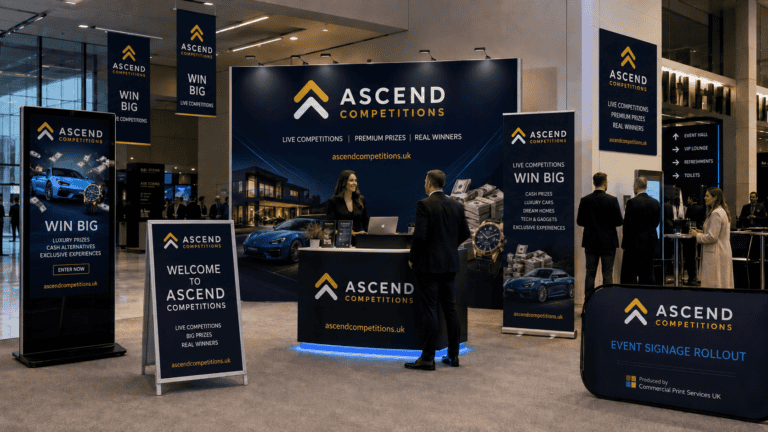
An illuminated sign does something a non-illuminated sign cannot: it works at night. In a country where winter daylight disappears by half past four, that is not a trivial advantage. Illuminated signage extends your brand visibility by six or more hours per day for half the year, and it communicates permanence, professionalism and investment in a way that unlit alternatives simply do not match.
We manufacture and install illuminated signage as part of our signage manufacturing service, from single-unit shop fascias to multi-site illuminated rollout programmes. This guide covers the main illumination technologies, their relative costs, energy consumption, maintenance requirements, and the regulatory considerations you need to address before installation.
Key takeaways
- LED is now the dominant illumination technology for commercial signage, having largely replaced fluorescent and neon across all applications
- The three main illuminated sign types are illuminated lightbox fascias, individually illuminated letters (face-lit or halo-lit), and illuminated projecting signs
- LED signage typically consumes 50-70% less energy than equivalent fluorescent installations and has a rated lifespan of 50,000-100,000 hours
- Almost all illuminated signs require express advertisement consent from the local planning authority deemed consent provisions are extremely restrictive
- Electrical installation must comply with BS 7671 and be carried out by a competent person registered with NICEIC, NAPIT or an equivalent approved scheme
- Ongoing maintenance costs for LED signage are significantly lower than fluorescent, with typical maintenance intervals of five to seven years
LED vs Fluorescent vs Neon: The Technology Landscape
The commercial signage industry has undergone a fundamental technology shift over the past fifteen years. LED (light-emitting diode) modules have replaced fluorescent tubes and neon glass as the standard illumination source for virtually all new sign installations. Understanding why helps explain the cost and performance characteristics of modern illuminated signage.
Fluorescent tubes were the workhorse of illuminated signage from the 1960s through to the early 2010s. They produce good light output at reasonable cost, but they have a limited lifespan (typically 10,000-15,000 hours), they contain mercury (creating disposal obligations), they lose brightness progressively over their life, and they are physically fragile a common maintenance issue is tube breakage during relamping.
Neon (gas-discharge tubes bent into letter shapes) produces a distinctive warm glow that remains popular for heritage, hospitality and creative applications. Traditional neon runs at high voltage (3,000-15,000 volts), requires specialist glass bending, and is relatively expensive to produce and maintain. LED neon flex a flexible LED strip designed to mimic the appearance of neon now offers a similar aesthetic at lower cost, lower voltage and lower maintenance.
LED modules dominate new installations because they offer the best combination of energy efficiency (50-70% less power consumption than fluorescent), longevity (50,000-100,000 hours rated life), colour consistency (no progressive colour shift), compactness (modules fit into shallow sign cases where tubes would not), and low maintenance. The higher initial cost of LED compared to fluorescent is recovered within two to three years through energy savings alone.
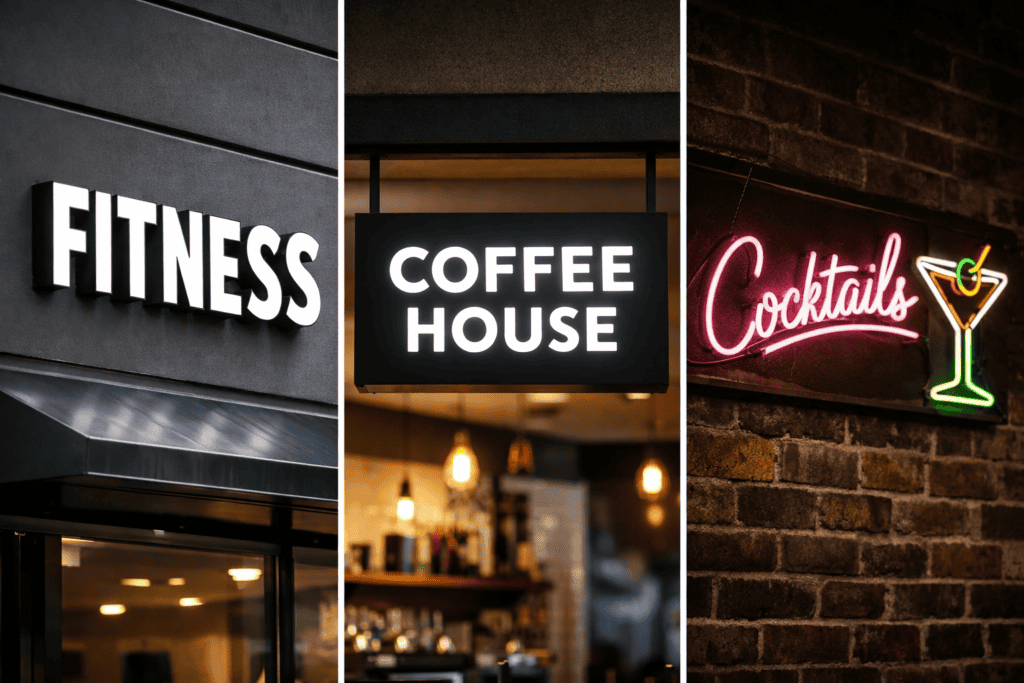
Illuminated Lightbox Fascia Signs
The lightbox fascia is the most common illuminated sign format for retail premises. It consists of an aluminium frame (typically 100-150mm deep), LED modules mounted inside, and a translucent acrylic or polycarbonate face panel carrying the graphics. The LEDs illuminate the face panel from behind, creating an evenly lit sign that is visible from distance in daylight and dominant at night.
Face panels are either digitally printed translucent vinyl applied to opal acrylic, or for higher-end installations cut vinyl lettering on opal acrylic with selected areas of colour translucency. The printing and vinyl work must account for the backlighting: colours that look correct in ambient light may appear washed out or oversaturated when illuminated from behind. Backlit colour proofing is a specific skill that requires different colour management from standard front-lit print.
Standard lightbox depths range from 80mm (slim, modern aesthetic) to 200mm (traditional, higher light output). Shallower cases require more LED modules spaced more closely to avoid hot spots bright patches directly in front of each LED that create a visible dot pattern through the face panel. Well-engineered lightbox signs use diffuser layers, correct LED spacing calculations and even light distribution to eliminate hot spotting entirely.
Individually Illuminated Letters
Individual letters sometimes called built-up letters or channel letters are three-dimensional letter forms mounted directly onto the building facade, each containing its own LED illumination. They are the premium option for commercial signage, projecting a level of quality and brand investment that flat fascia signs cannot replicate.
Two illumination approaches dominate. Face-lit letters have a translucent acrylic face and opaque returns (sides), with LEDs mounted inside the letter cavity illuminating the face. The face glows with the brand colour while the sides remain dark, creating a clean, modern appearance. Halo-lit letters (also called reverse-lit or back-lit) have an opaque face and open or reflective rear, with LEDs projecting light backwards onto the building surface. This creates a glow effect around each letter that is visually distinctive and particularly effective on light-coloured facades.
Some installations combine both approaches face-lit lettering with a secondary halo effect for maximum visual impact. For a comparison of fabricated letter types, see our guide to fascia sign materials and styles.
Letter construction is typically aluminium (returns and back panel) with acrylic (face). Stainless steel returns are used for premium installations. Each letter is wired to a driver unit that converts mains voltage to the low-voltage DC supply required by the LED modules. The driver units are either mounted inside the letters or in a concealed location with cables routed through the building fabric.
Projecting and Totem Signs
Projecting signs also called blade signs or hanging signs extend outward from the building facade to catch the attention of pedestrians and passing traffic approaching from either direction along the street. They are particularly effective on high streets and in areas with restricted sightlines where a flat fascia sign may not be visible from an oblique angle.
Illuminated projecting signs are typically double-sided lightbox constructions, round or rectangular, mounted on a fabricated bracket that transfers the load into the building structure. The bracket design must account for wind loading a projecting sign acts as a sail and generates significant lateral force in high winds. Structural calculations are required for most projecting sign installations.
Totem signs are freestanding illuminated structures, typically 2-4 metres tall, located at site entrances, car park entries and campus wayfinding points. They require concrete foundations, electrical ducting from the building supply, and almost always require both planning permission (for the structure) and advertisement consent (for the sign face).
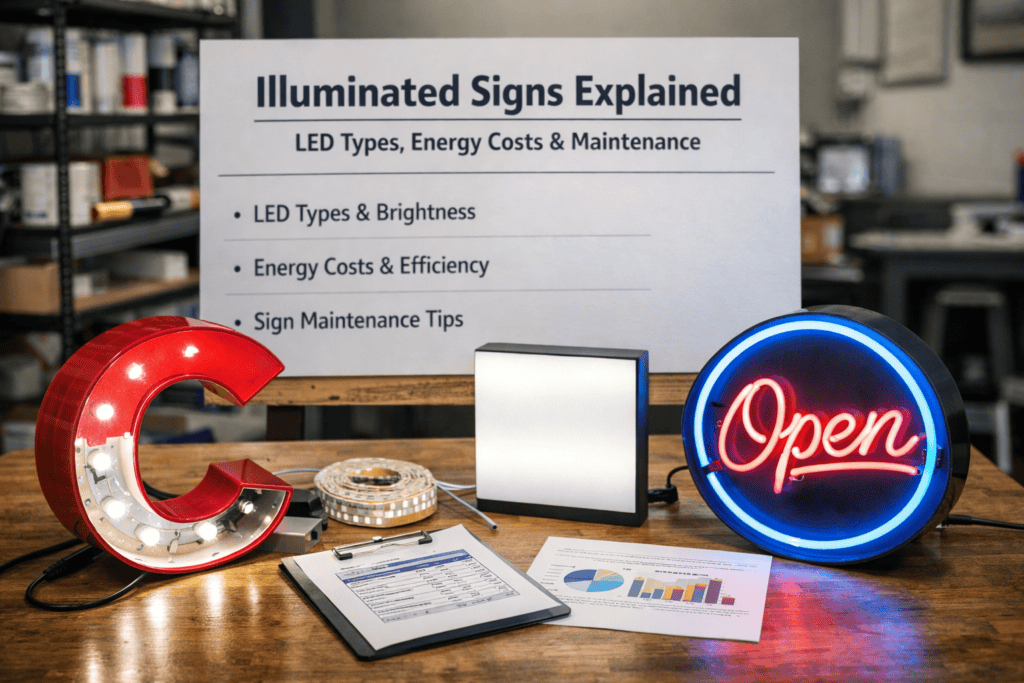
Energy Costs and Running Economics
Illuminated signage represents a fixed overhead cost that runs year after year, so the energy economics are worth understanding. A typical illuminated fascia sign (3 metres by 0.6 metres) using LED modules consumes approximately 150-250 watts. Running for 12 hours per day, 365 days per year, at a commercial electricity rate of 30p per kWh, the annual energy cost is approximately £200-£330.
The equivalent fluorescent installation would consume approximately 400-700 watts for the same sign dimensions, with an annual energy cost of £525-£920. Over a typical ten-year sign lifecycle, the LED installation saves £3,000-£6,000 in energy costs alone more than covering the modest premium for LED modules over fluorescent tubes at the point of manufacture.
LED drivers (the power supply units) have a rated lifespan of approximately 50,000 hours, which translates to roughly 11 years at 12 hours per day. Driver replacement is the most common maintenance requirement for LED signage and is a straightforward swap that does not require replacing the sign itself.
Planning Permission and Regulations
Illuminated signs are subject to stricter planning controls than non-illuminated equivalents. As covered in our guide to signage planning permission requirements, the deemed consent provisions for illuminated signs are extremely restrictive effectively, any commercially useful illuminated sign requires express advertisement consent from the local planning authority.
The application will need to specify the illumination method, light source, luminance (measured in candelas per square metre), and proposed hours of operation. Planning officers assess illuminated signage against both amenity (visual impact on the area) and public safety (risk of distraction to road users, glare, light pollution) criteria.
Conservation areas, Areas of Outstanding Natural Beauty and locations near residential properties face additional scrutiny. Some local planning authorities impose maximum luminance values (typically 300-600 cd/m² for commercial areas, 100-300 cd/m² near residential) and restrict illumination hours (for example, switching off between 23:00 and 07:00).
Electrical work must comply with Part P of the Building Regulations and BS 7671 (IET Wiring Regulations). Installation must be carried out or certified by a competent person registered with NICEIC, NAPIT or an equivalent approved scheme. An Electrical Installation Certificate (EIC) must be issued on completion.
Maintenance and Lifespan
LED illuminated signs require less maintenance than any previous technology, but they are not maintenance-free. A sensible maintenance programme includes annual visual inspection (checking for failed LEDs, discolouration, water ingress, physical damage), cleaning the face panel (accumulated dirt reduces light output and makes colours appear dull), checking fixings and brackets for corrosion or loosening, and verifying the electrical installation remains safe and compliant.
LED module failure typically presents as individual dark spots within the sign rather than total failure. Because LEDs degrade gradually rather than failing catastrophically, the transition from “fully operational” to “needs attention” can be subtle regular inspection catches degradation before it becomes noticeable to passers-by.
Face panel replacement is required when the printed or vinyl graphics fade, typically after five to seven years for standard digitally printed panels. The aluminium case and LED modules typically last ten to fifteen years, so a mid-life face panel refresh extends the sign’s effective lifespan without the cost of a complete replacement.
If you are considering illuminated signage for your premises or a multi-site programme, get a signage quote and we will advise on the best approach for your specific requirements.
Frequently Asked Questions
How much does an illuminated shop sign cost?
A standard LED-illuminated lightbox fascia sign (3 metres by 0.6 metres) typically costs between £1,500 and £3,500 including manufacture, graphics and installation. Individually illuminated built-up letters cost more typically £3,000 to £8,000 for a standard shop frontage due to the higher manufacturing complexity. Costs vary with materials, illumination type, access requirements and location.
Do all illuminated signs need planning permission?
Almost all illuminated signs require express advertisement consent from the local planning authority. The deemed consent provisions for illuminated business signs are restricted to 0.3 square metres at ground floor level, which is too small for most commercial applications. We handle the consent application process as part of our signage service.
How long do LED signs last?
LED modules have a rated lifespan of 50,000 to 100,000 hours. At 12 hours per day operation, this translates to 11 to 23 years. In practice, the sign case and fixings determine the overall lifespan typically 10 to 15 years before a full replacement is needed. Face panel graphics are usually refreshed at the 5 to 7 year mark.
Can you convert my fluorescent sign to LED?
In most cases, yes. LED retrofit modules can be installed into existing sign cases, replacing the fluorescent tubes and ballasts. This reduces energy consumption by 50-70% and improves light distribution. The retrofit typically takes half a day per sign and costs significantly less than a complete sign replacement.
What about digital or changeable signs?
Digital LED displays and electronic message centres are available but require specific planning consent, which is harder to obtain than consent for static illuminated signs. Local planning authorities are cautious about digital signage due to road safety concerns and visual amenity impacts. We can advise on the feasibility and consent requirements for digital signage at your specific location.
How bright should an illuminated sign be?
Brightness depends on the environment. A high street sign competes with shop lighting and streetlamps, requiring higher luminance (typically 300-800 cd/m²) than a sign on an unlit industrial estate. Overly bright signs can cause complaints and enforcement action. We specify luminance levels appropriate to the location and in compliance with any planning conditions.