Exhibiting for the first time is an exercise in discovering how many things you did not know you needed to think about. The stand design gets most of the attention, but it is the graphic production, ordering timelines, venue logistics and installation practicalities that determine whether your first exhibition goes smoothly or turns into an expensive education in what can go wrong.
We produce exhibition and event graphics for first-time exhibitors through to seasoned show veterans, and the questions from both groups are remarkably consistent. This guide covers the practical decisions you need to make, the graphics you need to order, and the timelines you need to work to.
Key takeaways
- Start graphic production planning at least six weeks before the show four weeks for production, two weeks as buffer for revisions, venue changes and delivery logistics
- Shell scheme stands and custom-build stands have fundamentally different graphic requirements, so confirm your stand type before commissioning any artwork
- Fabric graphics printed by dye-sublimation have become the default for backdrops, tension frames and hanging banners due to their portability, crease recovery and reusability
- Most UK exhibition venues have strict delivery windows, vehicle restrictions and mandatory handling charges check these before arranging your own transport
- Portable display systems (pop-up stands, roller banners, fabric frames) provide a complete exhibition presence that you can transport in a car and set up without tools
- Budget for replacement graphics if you plan to exhibit more than twice per year show floor wear accumulates faster than most exhibitors expect
Shell Scheme vs Custom Build: What It Means for Graphics
The type of exhibition stand you have booked determines everything about the graphics you need. A shell scheme stand is a pre-built modular enclosure provided by the venue or organiser typically white or grey panels (usually 1 metre wide by 2.5 metres high), a fascia board with your company name, basic lighting and carpet. You fill the interior with your own graphics and furniture.
A custom-build (also called space-only) stand means you have booked a floor area and nothing else. You design and build the entire stand structure, walls, graphics, lighting, flooring and furniture from scratch. Custom builds offer complete design freedom but require significantly more planning, budget and lead time.
For shell scheme stands, the graphic options include printed panels that sit within or in front of the shell panels, tension fabric displays that cover the shell walls, roller banners for flexible positioning, and counter graphics. The key dimensions to confirm are the panel width (typically 1 metre but varies between venues), the panel height (typically 2.5 metres but can be 2.4 or 2.7 metres), and the number of open sides (which determines how many panels you have to cover).
For custom builds, the graphic scope is limited only by budget and imagination. Full-height fabric backdrops, illuminated lightbox walls, suspended hanging banners, printed flooring, projection surfaces and integrated digital screens are all common elements. The graphic specification is driven by the stand designer, and production timelines are typically tighter because the stand design finalises later in the process.

Fabric Graphics: The Default Choice
Dye-sublimation printed polyester fabric has become the standard material for exhibition graphics over the past decade, and for good reasons. Fabric is lightweight (a 3-metre by 2.5-metre backdrop weighs under 2kg), it folds into a bag the size of a laptop case, it recovers from creasing within hours of being tensioned onto a frame, it eliminates the glare that PVC banners produce under exhibition hall lighting, and it can be machine-washed between shows.
For a detailed comparison of fabric versus vinyl for exhibition use, see our guide to fabric backdrops vs vinyl graphics.
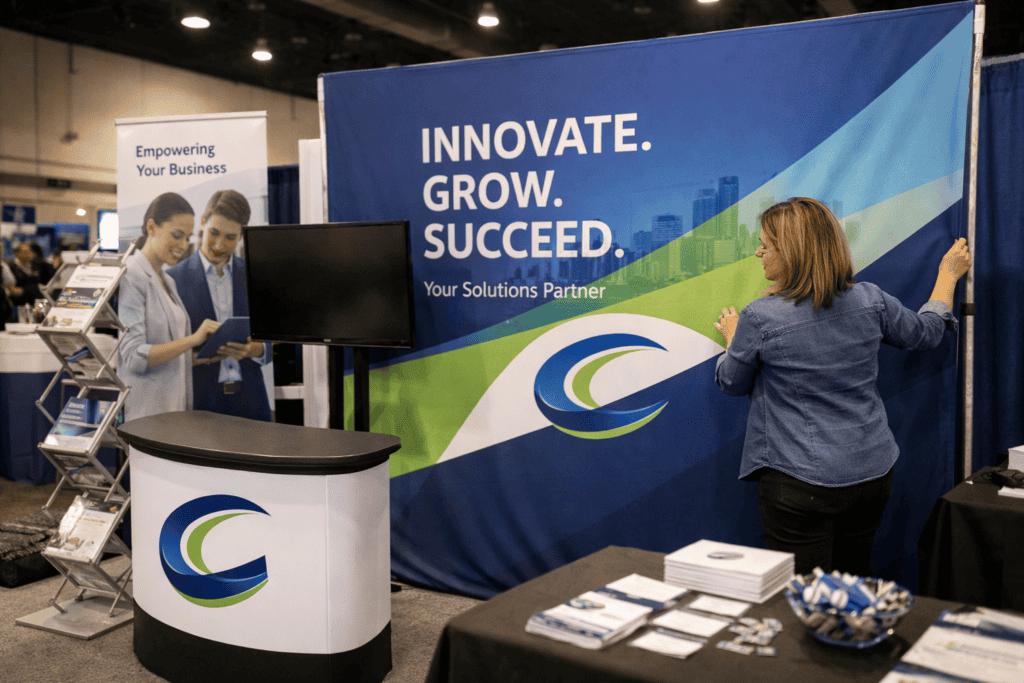
Fabric graphics work with several hardware systems. Tension fabric displays use an aluminium frame with a silicone-edged graphic (SEG) that pushes into a channel around the frame perimeter, pulling the fabric taut for a smooth, frame-free appearance. Pop-up fabric displays use a concertina frame with the fabric attached directly, collapsing into a compact carry case. Hanging banners use fabric printed as tubes, cones or flat shapes, suspended from the exhibition hall ceiling above the stand.
The production process involves printing the artwork onto transfer paper using dye-sublimation inks, then heat-pressing the paper against the polyester fabric at 200°C. The heat converts the ink to gas, which penetrates the polyester fibres and solidifies within them. The result is a print that is part of the fabric rather than sitting on its surface it cannot crack, peel or scratch off.
Portable Display Systems
If your exhibition programme involves multiple shows, regional events, or conferences where you need a professional presence without a full stand build, portable display systems offer the best balance of visual impact, portability and cost.
Roller banners (pull-up banners) are the simplest and most widely used portable display. The graphic retracts into a base unit and extends upward on a spring-loaded mechanism. Standard widths are 800mm, 850mm and 1000mm; standard height is 2 metres. They transport in a padded carry bag, weigh 5-8kg, and set up in under 30 seconds. Quality varies enormously between manufacturers economy rollers with thin aluminium bases and plastic mechanisms have a lifespan of a few shows, while premium rollers with weighted steel bases and reliable mechanisms last years.
Pop-up displays use a folding lattice frame that expands to create a curved or flat wall, onto which printed panels or a continuous fabric graphic is attached. A 3×3 curved pop-up creates a backdrop approximately 3.2 metres wide by 2.2 metres high and collapses into a wheeled case that doubles as the counter. They take 10-15 minutes to assemble without tools.
Modular fabric systems including tension frames, link systems and portable lightboxes offer more design flexibility than pop-ups and a more premium appearance. They are slightly heavier and take longer to assemble, but they create a stand presence that approaches the quality of a custom build at a fraction of the cost.
Artwork and Production Specifications
Exhibition graphic artwork has specific requirements that differ from standard print. Viewing distances are typically 1-5 metres (not the 30cm of a brochure), which means fine detail and body copy smaller than 20pt are wasted. Conversely, any imperfection in image resolution, colour banding or artefacting is visible at arm’s length, so source images must be high resolution (150 dpi minimum at output size for fabric; 300 dpi for close-viewing graphics).
Colour management for fabric print differs from rigid and vinyl print. Dye-sublimation inks have a wide colour gamut but behave differently from CMYK inkjet inks some Pantone colours (particularly bright oranges and reds) reproduce differently on fabric than they do on paper or vinyl. If brand colour accuracy is critical, request a large format print colour proof on the actual production fabric before approving the full run.
File formats should be print-ready PDF, TIFF or EPS with fonts outlined and images embedded. Include 50-100mm bleed on all edges. If the graphic includes a silicone edge (SEG) for a tension frame system, the bleed requirement increases to accommodate the sewn channel typically 70mm per edge. Your graphic supplier will provide a template specific to the hardware system being used.
Venue Delivery and Logistics
UK exhibition venues have delivery procedures that catch first-time exhibitors off guard. Most major venues (NEC, ExCeL London, Olympia, Manchester Central, SEC Glasgow) operate managed delivery systems where exhibitors cannot simply drive up and unload. Vehicles must be booked into allocated delivery slots, sometimes weeks in advance, and the venue charges handling fees for palletised goods received through the loading bay.
For shell scheme exhibitors with portable displays, the simplest approach is to carry your graphics and hardware directly onto the show floor during build-up. Most venues allow this via designated exhibitor entrances without delivery charges provided you can physically carry or trolley the items yourself. This is one of the practical advantages of lightweight fabric graphics and portable display systems.
For custom-build stands with large-format graphics, the delivery must be coordinated with the stand contractor’s build schedule. Graphics that arrive before the stand structure is ready have nowhere to go; graphics that arrive after the build deadline cannot be installed. The typical delivery window for custom-build graphics is the second day of the build-up period, but this varies by show and by stand contractor.
Timeline: When to Order What
Working backwards from the show opening date, here is a realistic production timeline for exhibition graphics:
Six weeks before: Confirm stand type, dimensions and graphic scope. Brief your graphic supplier with all specifications and artwork requirements.
Five weeks before: Supply final artwork files. Allow three to five working days for pre-press checks, colour proofing (if requested) and any artwork amendments.
Four weeks before: Graphic production begins. Standard lead time for fabric backdrops, tension frame graphics and roller banners is five to ten working days depending on complexity and volume.
Two weeks before: Graphics delivered. Inspect all items check dimensions, colours, finishing (hems, SEG channels, eyelets) and hardware compatibility. This is your buffer for any reprints or corrections.
One week before: Pack everything. Create a checklist of every item being taken to the show. Include tools, fixings, cleaning materials, spare cable ties and a basic repair kit.
If you have an exhibition coming up and need graphics produced, brief us on your next event and we will work backwards from your show date to confirm production timelines.
Frequently Asked Questions
How far in advance should I order exhibition graphics?
Allow at least four weeks from final artwork approval to delivery, plus one to two weeks buffer for revisions. For first-time exhibitors, brief your supplier six weeks before the show to allow time for artwork development and any hardware procurement.
Can I reuse exhibition graphics at multiple shows?
Yes. Fabric graphics are machine-washable and can be reused many times. Roller banner graphics typically last 20-30 shows if handled carefully. We recommend carrying graphics in protective cases and inspecting them after each event. Budget for replacement graphics annually if you exhibit more than four times per year.
What is the difference between a shell scheme and a custom build?
A shell scheme is a pre-built modular stand enclosure provided by the organiser you fill it with your own graphics and furniture. A custom build means you have booked bare floor space and must design and construct the entire stand. Shell schemes are faster, cheaper and simpler; custom builds offer complete design freedom but cost significantly more.
Do I need to hire an exhibition stand designer?
For a shell scheme stand using portable display systems, no you can create an effective presence with well-designed graphics on standard hardware. For a custom-build stand, a specialist stand designer is strongly recommended to manage the structural design, venue compliance and build logistics.
How do I get my graphics to the venue?
For portable displays, carry them directly onto the show floor during build-up no delivery booking or handling charges needed. For larger items, book a delivery slot with the venue in advance. Check the venue’s exhibitor manual for delivery procedures, vehicle restrictions and handling fees.
What size graphics do I need for a shell scheme stand?
Standard shell scheme panels are 1 metre wide by 2.5 metres high, but this varies between venues and organisers. Always confirm the exact panel dimensions with the organiser before commissioning artwork. A 3-metre-wide stand typically has three back panels and two side panels (if your stand is not open-sided), giving approximately 7.5 square metres of graphic area.