Interior wall graphics have become one of the most requested services in commercial print, and for good reason. A printed wall transforms dead space into brand storytelling, wayfinding, culture reinforcement or simple visual interest and it does so at a fraction of the cost of traditional interior finishes like bespoke wallpaper, paint effects or cladding.
We produce and install interior wall graphics as part of our large format printing service, covering everything from single feature walls to full building interior programmes across corporate offices, retail environments, healthcare facilities, education campuses and hospitality venues. This guide covers the material options, surface preparation requirements, design considerations and installation practicalities.
Key takeaways
- Self-adhesive vinyl is the most versatile material for interior wall graphics, available in printable, coloured, textured and speciality finishes
- Self-adhesive fabric wallcovering offers a premium textile appearance with repositionable installation ideal for large unbroken surfaces
- Surface preparation is the single biggest factor in installation quality and longevity contaminated, damp or unstable surfaces cause adhesion failure regardless of material quality
- Fire-rated materials (Class 0 or B1) are mandatory for most commercial interior installations in the UK
- Wall graphics are a temporary-to-semi-permanent installation plan for removal and surface restoration from the outset
- Design for the space, not just the artwork viewing distances, lighting conditions, architectural features and furniture placement all affect how wall graphics are perceived
Material Options for Interior Walls
The material choice for wall graphics depends on the wall surface, the desired visual effect, the expected lifespan, the installation environment and whether a fire rating is required. The main categories are self-adhesive vinyl, self-adhesive fabric, rigid panel mounting and direct-to-wall print.
Self-adhesive vinyl is the standard choice for most commercial wall graphics. Polymeric or cast vinyl with a pressure-sensitive adhesive is printed, laminated (for durability and scuff resistance) and applied directly to the wall surface. For a comprehensive guide to vinyl types and their properties, see our print substrates guide.
Standard calendered vinyl works on smooth, flat walls (plasterboard, painted smooth plaster, glass, metal). For textured surfaces (lightly textured plaster, painted brick with a smooth finish), a thicker conformable vinyl with high-tack adhesive is required to bridge the surface texture without lifting at the edges.
Self-adhesive fabric wallcovering provides a textile finish that looks and feels like premium wallpaper. It is printed by dye-sublimation, producing vibrant colours with no surface ink layer to crack or peel. The adhesive is repositionable during installation, allowing the installer to lift and reapply sections without damage a significant advantage on large wall spans where perfect alignment first time is difficult. Fabric wallcovering is also tear-resistant and breathable, making it suitable for environments where vinyl might trap moisture.
Rigid panel mounting involves printing onto a rigid substrate (foamex, dibond or acrylic) and fixing the panels to the wall using adhesive, standoff fixings or a rail system. This approach works on surfaces that are unsuitable for direct vinyl application rough brickwork, exposed concrete, uneven plaster and creates a floating panel effect that adds depth and visual interest.
Surface Preparation: The Make-or-Break Step
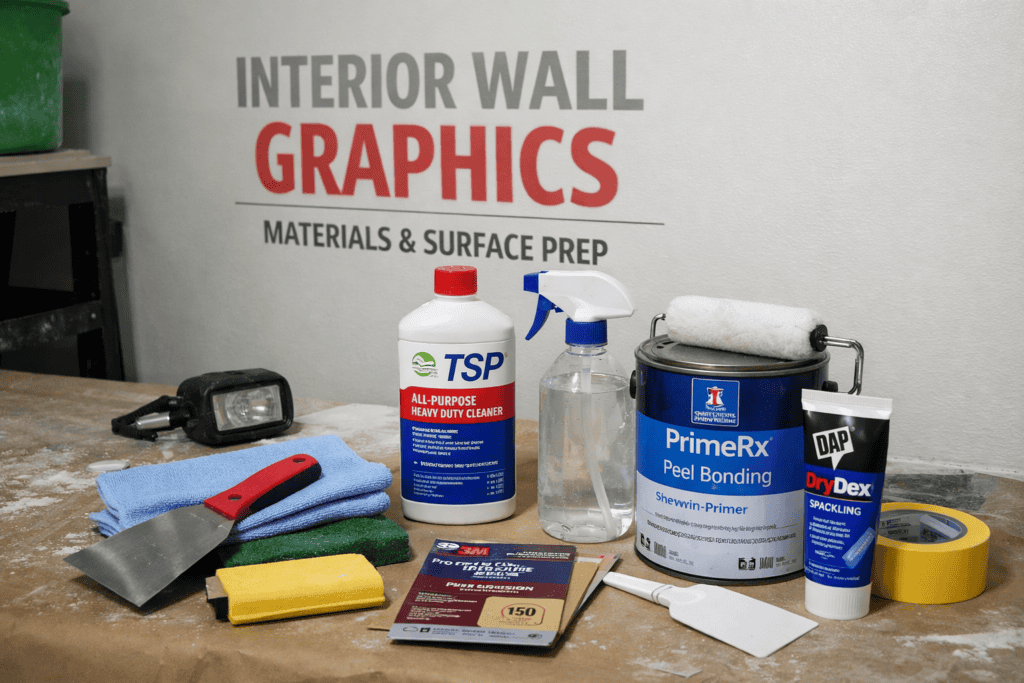
More wall graphic installations fail due to poor surface preparation than any other cause. The adhesive can only perform as well as the surface it is bonding to. A contaminated, damp, powdery or recently painted surface will cause adhesion failure usually within days, always within weeks.
Before any installation, the wall surface must be assessed for contamination (dust, grease, silicone residues, cleaning product residues), moisture content (measured with a moisture meter vinyl will not adhere reliably to surfaces with moisture readings above 75% relative humidity), paint condition (peeling, flaking, powdery or chalking paint must be removed and the surface recoated with a vinyl-compatible primer), and surface texture (deep textures, heavy stipple or rough render require either surface preparation or a switch to rigid panel mounting).
Freshly painted walls need a minimum of two weeks’ curing time before vinyl application. Newly plastered walls need a minimum of four weeks. These are non-negotiable timescales applying vinyl to uncured surfaces traps moisture behind the graphic, causing bubbling, adhesion loss and potential mould growth.
Fire Ratings for Commercial Interiors
Any printed material installed on a wall in a commercial, public or institutional building must comply with fire safety regulations. In England and Wales, this typically means achieving a Class 0 surface spread of flame rating under BS 476: Parts 6 and 7, or the European B-s1,d0 classification under EN 13501-1.
Most major vinyl and fabric wallcovering manufacturers offer fire-rated variants within their standard product ranges. The fire rating applies to the complete system substrate, ink, laminate and adhesive not just the base material. We supply fire rating certificates for every material used in commercial installations and can provide test certificates on request.
Healthcare environments (NHS and private), education facilities and hospitality venues may have additional requirements beyond the standard Class 0 rating. Always confirm the specific fire safety requirements with the building manager or fire safety officer before specifying materials.
Design Considerations for Wall Graphics
Designing for a wall is fundamentally different from designing for print. A wall graphic is experienced in three dimensions the viewer moves through the space, sees the graphic from changing angles and distances, and experiences it alongside furniture, lighting, people and architectural features.
Viewing distance matters. In a corridor, the typical viewing distance is 1-3 metres. In a large open-plan office or atrium, it may be 5-20 metres. Text that is legible at 2 metres disappears at 10 metres. Images that look detailed at arm’s length become muddy blocks of colour from across a room. Design the content for the actual viewing conditions, not for the artwork proof viewed on a monitor at 50cm.
Lighting affects colour perception significantly. The same print will appear different under daylight, fluorescent tubes, warm-white LED panels and feature spotlights. If colour accuracy matters (brand colours, product photography, paint colour references), assess the lighting conditions during the site survey and account for them in the colour management process.
Architectural features create design opportunities and constraints. Windows, doors, columns, power outlets, switches and fire equipment must be accommodated in the graphic layout. The best wall graphic designs work with the architecture rather than fighting against it wrapping around corners, framing doorways, or using structural elements as compositional anchors.
Installation Process
Professional wall graphic installation follows a systematic process. The wall is cleaned with isopropyl alcohol to remove surface contaminants. The graphic is positioned dry (without removing the liner) to confirm alignment, levelling and registration with architectural features. Starting from one edge, the liner is peeled back progressively and the vinyl is applied using a squeegee to exclude air and ensure full adhesive contact.
Large wall graphics are produced in panels (typically 1.2-1.5 metres wide) that are butted edge-to-edge or overlapped by 2-3mm depending on the material and the visual design. Seam placement is planned during the pre-press stage to minimise visibility ideally falling on natural break points in the design (colour transitions, shadow areas, architectural features) rather than across faces, gradients or areas of solid colour.
For multi-wall installations or full-room wraps, the installation sequence is planned to ensure panels align correctly across internal corners, around door frames and over window reveals. This requires precise measurement during the site survey and careful artwork preparation errors compound across multiple walls and cannot be corrected mid-installation.
Removal and Surface Restoration
Wall graphics are inherently temporary. Even the most durable installation will eventually need replacing because the brand refreshes, the tenant changes, the campaign ends, or the graphic reaches the end of its useful life. Planning for removal at the specification stage avoids expensive surface damage later.
Standard polymeric vinyl with permanent adhesive can be removed cleanly from most painted surfaces within five to seven years of installation. Beyond that timeframe, the adhesive cures further and removal becomes more difficult, potentially pulling paint from the wall surface. If the graphic may need to stay in place for longer than five years, specify a removable adhesive variant from the outset.
After removal, adhesive residue is cleaned with a citrus-based solvent. Minor surface damage (paint lifting, residue staining) can usually be resolved with a localised repaint. If the wall is going to receive new graphics, this is an opportunity to prepare the surface properly before the next application.
If you have a wall graphics project to discuss, brief us on your interior graphics and we will advise on materials, surface preparation and installation approach.
Frequently Asked Questions
Can you print wall graphics for textured walls?
Yes, with the right material. Standard vinyl works on smooth and lightly textured surfaces. Heavily textured walls (deep stipple, rough render, exposed brick) require either a thick conformable vinyl with high-tack adhesive or rigid printed panels mounted with standoff fixings. We assess the wall surface during the site survey and recommend the appropriate material.
How long do wall graphics last?
Interior wall graphics typically last five to seven years before showing signs of edge lifting, colour fading or adhesive deterioration. In high-traffic areas with frequent contact (corridors, stairwells, reception desks), a protective laminate extends the useful life by adding scuff and abrasion resistance. The graphics can be replaced without redecorating the wall in most cases.
Do wall graphics damage the paint underneath?
If the original paint is well-adhered and fully cured, and the graphic is removed within the recommended lifespan (typically five to seven years), damage is minimal. Slight colour difference between the covered and uncovered areas is normal due to differential UV exposure and ageing. Using a removable adhesive variant reduces the risk of paint pulling during removal.
Can you install wall graphics in occupied offices?
Yes. We routinely install in occupied spaces during and outside business hours. The installation process is quiet (no power tools required for vinyl application), produces no dust or fumes, and can be completed in sections to minimise disruption. We provide protective floor covering to prevent any adhesive or cleaning solvent reaching carpets or hard flooring.
What resolution do I need for wall graphics artwork?
For viewing distances of 1-2 metres (corridors, meeting rooms), supply artwork at 150 dpi at output size. For large-scale graphics viewed from 3 metres or more (atriums, open-plan offices), 100 dpi is sufficient. Photographic images should be the highest resolution available. We check artwork resolution during pre-press and flag any issues before production.
Are wall graphics fire-rated?
Fire-rated vinyl and fabric wallcovering materials are available and are specified as standard for all commercial interior installations. We supply Class 0 (BS 476) and B-s1,d0 (EN 13501-1) rated materials with fire certificates provided for each project. Non-fire-rated materials are only used in domestic or non-public settings where fire regulations do not apply.