Installing a commercial sign in the UK is rarely as simple as choosing a design and bolting it to a building. Depending on the sign type, size, location and whether it is illuminated, you may need formal planning permission, advertisement consent, building regulations approval, or a combination of all three. The consequences of getting this wrong range from an enforcement notice requiring removal at your expense to prosecution and fines.
We handle commercial signage solutions for businesses across the UK, and planning compliance is one of the most common areas where clients need guidance. This guide explains the legal framework, what requires consent, what benefits from deemed consent, and how to avoid the pitfalls that delay or derail signage projects.
Key takeaways
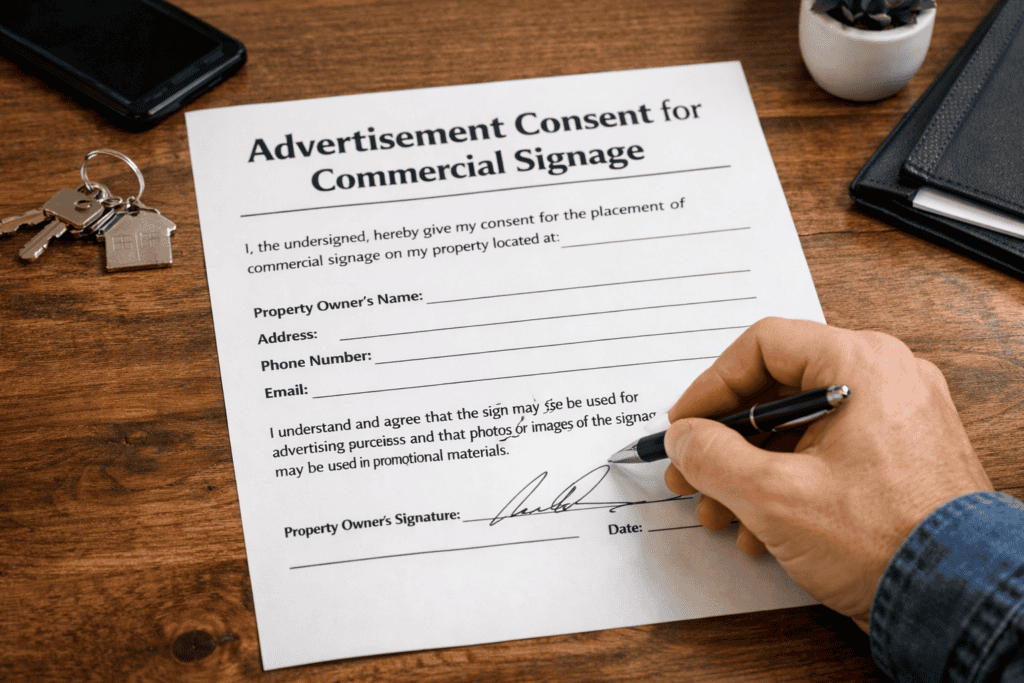
- Most commercial signs in England require “advertisement consent” from the local planning authority, which is separate from standard planning permission
- Some signs benefit from “deemed consent” under the Town and Country Planning (Control of Advertisements) (England) Regulations 2007, meaning they can be displayed without a formal application but strict conditions apply
- Illuminated signs almost always require express advertisement consent, with very few exceptions
- Listed buildings, conservation areas, Areas of Outstanding Natural Beauty and national parks have significantly stricter controls
- Building regulations approval may be required separately for signs that affect structural loading, electrical safety or means of escape
- Enforcement is handled by local authority planning departments and can result in removal orders, prosecution and fines of up to £2,500 per offence
The Legal Framework: Advertisement Consent vs Planning Permission
Commercial signs in England and Wales are controlled primarily through advertisement consent regulations rather than the standard planning permission process. The governing legislation is the Town and Country Planning (Control of Advertisements) (England) Regulations 2007 (as amended), which defines what constitutes an advertisement, what conditions must be met, and when formal consent is needed.
Advertisement consent is technically a separate regime from planning permission, though it is administered by the same local planning authority (LPA). The two key grounds on which the LPA assesses applications are “amenity” (visual impact on the surrounding area) and “public safety” (particularly whether a sign could distract road users or obscure sightlines).
Planning permission in the traditional sense only becomes relevant when the sign involves physical alterations to a building for example, constructing a projecting bracket, building a freestanding sign structure, or modifying a shopfront. In those cases, you may need both planning permission for the structure and advertisement consent for the sign face.
What Benefits from Deemed Consent
Certain categories of advertisement can be displayed without making a formal application, provided they comply with specific size, location and illumination conditions. These “deemed consent” categories are set out in Schedule 3 of the 2007 Regulations. The most commercially relevant classes include:
Class 3A Business premises signs: A sign on the building where the business operates, displaying the business name, the nature of the business, or both. For ground-floor premises, the sign must not exceed 0.3 square metres if illuminated, or project more than 1 metre from the building face. Non-illuminated fascia signs have more generous size allowances but must still be below first-floor window sill level.
Class 5 Directional signs: Signs not exceeding 0.3 square metres directing people to business premises. Must not be illuminated and must be within a reasonable distance of the premises.
Class 12 Temporary sale or letting signs: Boards advertising property for sale or to let. Size restrictions vary depending on whether the property is residential or commercial.
The conditions are prescriptive and the thresholds are tight. A common mistake is assuming deemed consent is a blanket permission it is not. If any single condition is breached (size, projection, illumination, height), deemed consent falls away and express consent is required.
When You Need Express Advertisement Consent
Express consent (a formal application to the local planning authority) is required for any sign that falls outside the deemed consent categories or that fails to meet the conditions. In practice, this includes most commercial signage projects of any significance:
Illuminated fascia signs, projecting signs, totem signs, large-format banners, building-mounted individual letters with halo or face illumination, freestanding monument signs, digital screens, and any sign within a designated area (conservation area, listed building curtilage, Area of Outstanding Natural Beauty, national park, or area of special control).
Applications are made to the local planning authority and typically take eight weeks for determination, though this can extend to thirteen weeks for major applications. The fee in England is currently £462 per application (subject to periodic increases). The LPA will assess the application against amenity and public safety criteria, and may impose conditions on size, materials, colour, illumination levels (measured in candelas per square metre) and hours of operation.
Listed Buildings, Conservation Areas and Sensitive Locations
If your premises are in or near a conservation area, or the building is listed, the planning constraints tighten considerably. Conservation areas are designated under the Planning (Listed Buildings and Conservation Areas) Act 1990 and are subject to additional controls intended to preserve the character and appearance of the area.
In conservation areas, deemed consent for many sign types is withdrawn entirely. Even modest non-illuminated signs that would normally benefit from deemed consent may require express consent if the LPA has made an Article 4 direction or a direction under Regulation 7 of the advertisement regulations withdrawing deemed consent for that area.
Listed building consent is required (in addition to advertisement consent) for any sign that involves fixing to, or altering, a listed building. This includes drilling into masonry, attaching brackets, installing electrical conduit, or any work that affects the building’s character. Unauthorised works to a listed building is a criminal offence carrying unlimited fines and up to two years’ imprisonment.
For national signage rollout programmes covering multiple locations, each site must be assessed individually. A sign design that receives consent in one borough may be refused in another, particularly where the local policy context differs.
Building Regulations and Structural Considerations
Building regulations sit alongside planning and advertisement consent as a separate compliance requirement. Signs that involve structural loading on a building may require structural calculations demonstrating that the building can support the additional weight and wind loading. This is particularly relevant for large fascia signs, projecting signs, totem structures and roof-mounted installations.
For illuminated sign regulations, any new electrical installation must comply with Part P of the Building Regulations (Electrical Safety) and BS 7671 (IET Wiring Regulations). The electrical work must be carried out or certified by a competent person registered with an approved scheme (such as NICEIC or NAPIT). An Electrical Installation Certificate must be issued on completion.
Signs installed above or adjacent to fire exits or means of escape may also require assessment under Part B (Fire Safety) of the Building Regulations. The sign must not obstruct escape routes, and any materials used must meet the relevant fire performance standards.
The Application Process: What to Submit and What to Expect
A robust advertisement consent application typically includes a completed application form (available from the Planning Portal), a location plan at 1:1250 scale, an elevation drawing showing the sign position on the building, dimensioned sign design drawings (typically at 1:20 or 1:50), details of materials and colours, illumination details (lux levels, hours of operation, light source type), and a supporting statement explaining the design rationale and addressing amenity and safety considerations.
For contentious applications particularly in conservation areas, near listed buildings, or for digital displays a design and access statement and a heritage impact assessment may be required. Some LPAs also request photomontages showing the proposed sign in context.
The determination period is eight weeks from validation. The LPA may approve the application unconditionally, approve with conditions (common conditions include time limits, illumination restrictions and maintenance requirements), or refuse. Refusals can be appealed to the Planning Inspectorate within eight weeks of the decision.
Enforcement: What Happens If You Get It Wrong
Local planning authorities have enforcement powers under Part 8 of the Town and Country Planning Act 1990 and the advertisement regulations. If a sign is displayed without the required consent, the LPA can issue a discontinuance notice requiring removal within a specified period (typically 28 days to 3 months).
Failure to comply with a discontinuance notice is a criminal offence. On conviction, the court can impose a fine of up to £2,500 and a daily fine of up to £250 for each day the offence continues. The LPA can also enter the land and remove the sign directly, recovering costs from the sign owner.
In practice, enforcement action varies between authorities. Some LPAs are proactive and will issue notices quickly; others take a more reactive approach. Regardless of the risk appetite, the cost of removing and replacing non-compliant signage particularly across a multi-site estate always exceeds the cost of getting the consents right before installation.
How We Help With Planning and Compliance
We handle advertisement consent applications as part of our signage service. For single-site projects, we prepare and submit the application with supporting drawings and documentation. For multi-site programmes, we carry out a planning assessment of each location, identify which sites need consent and which benefit from deemed consent, and manage the application process across multiple LPAs simultaneously.
This is particularly valuable for commercial signage rollouts where a standard sign specification must be adapted to meet different planning constraints across dozens or hundreds of locations. We flag potential refusal risks early, recommend design adaptations where needed, and manage the programme timeline to ensure consents are in place before installation teams arrive on site.
If you have a signage project with planning implications, contact us for planning advice before committing to a design. A brief pre-application assessment can save weeks of delay and thousands of pounds in abortive work.
Frequently Asked Questions
Do I need planning permission for a shop sign?
You need advertisement consent, which is a separate process from planning permission. Small, non-illuminated signs at ground-floor business premises may benefit from deemed consent (no application needed), but most commercial fascia signs particularly illuminated ones require express advertisement consent from your local planning authority.
How long does advertisement consent take?
The statutory determination period is eight weeks from the date the application is validated by the local planning authority. In practice, straightforward applications are often determined within six weeks. Applications in conservation areas or involving listed buildings may take longer due to additional consultation requirements.
Can I put up a sign while waiting for consent?
Displaying a sign before consent is granted is an offence and may result in an enforcement notice. If the sign is subsequently refused consent, you would be required to remove it at your own cost. It is always better to wait for formal consent before installation.
Do illuminated signs always need consent?
Almost always, yes. The deemed consent provisions for illuminated business signs are extremely restrictive (0.3 square metres maximum for ground-floor premises). In practice, any commercially useful illuminated sign will require express advertisement consent.
What happens if my sign is in a conservation area?
Conservation areas impose stricter controls on signage. Many deemed consent categories are withdrawn, and the local planning authority will assess applications against the additional objective of preserving or enhancing the character and appearance of the area. Expect longer determination times and more restrictive conditions on materials, colours and illumination.
Is advertisement consent permanent?
Standard advertisement consent is granted for a period of five years, after which it must be renewed. Some consents are granted for shorter periods if the LPA considers it appropriate. The expiry date will be stated in the consent decision notice. Deemed consent has no time limit but is conditional on the sign remaining compliant with all applicable conditions.