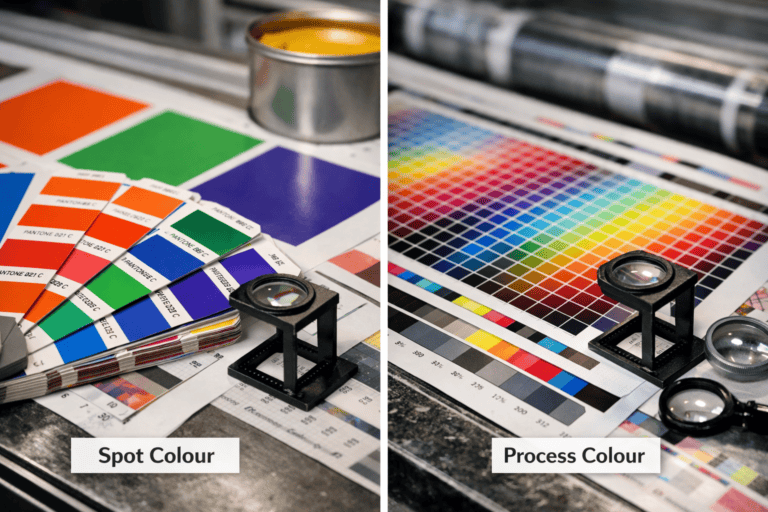
The quality of a print brief determines the quality of the print output. A good brief gives the production team everything they need to quote accurately, produce correctly and deliver on time. A poor brief creates a cycle of questions, assumptions, misunderstandings and revisions that costs more, takes longer and produces a result that nobody is entirely happy with.
We receive briefs every day some excellent, some missing critical information that halts the job before it starts. This guide is based on what we actually need to know, drawn from the questions we ask most frequently across large format print, signage, POS displays, exhibition graphics and colour sampling projects.
Key takeaways
- A complete brief answers five core questions: what is being produced, what size, what material, how many, and when is it needed
- Include the intended application environment indoor/outdoor, viewing distance, surface type, fire rating requirement because this drives material specification
- Supply artwork as print-ready files (PDF, TIFF, EPS) with fonts outlined, images embedded and bleed included not as PowerPoint slides, Word documents or low-resolution screen grabs
- State colour requirements explicitly: brand Pantone references, physical colour samples for matching, or “standard CMYK reproduction is acceptable”
- Include delivery details from the outset: address, access constraints, required delivery date, and whether installation is needed
- The ten minutes spent writing a thorough brief saves hours of back-and-forth and eliminates the most common causes of production errors
The Five Core Questions Every Brief Must Answer
1. What is being produced? This sounds obvious, but briefs that say “we need some graphics” without specifying what type of graphic wall vinyl, window film, banner, rigid panel, roller banner, signage create an immediate question. Be specific: “three wall vinyl graphics for a meeting room,” “a set of six roller banners for a conference,” “an illuminated fascia sign for our new premises.”
2. What size? Provide dimensions in millimetres for every item. If the sizes vary between locations, provide a schedule listing each item with its specific dimensions. For wall and window graphics, state whether the dimensions are the graphic size or the available wall/window size (they are different the graphic may be smaller than the wall, or may need bleed beyond the visible area).
3. What material? If you know the material you need, specify it. If you do not, describe the application environment and let the production team recommend. “Interior, smooth painted wall, five-year lifespan, Class 0 fire rating” gives us everything we need to specify the correct vinyl. “White sticky stuff for a wall” does not.
4. How many? State the quantity for each item. For multi-site programmes, provide a site schedule showing what each location receives. For rollout programmes, the site schedule is the foundation of the production plan without it, we cannot quote, plan production capacity or organise logistics.
5. When is it needed? Provide the required delivery date and, if applicable, the installation date. If the deadline is fixed (an event date, a store opening, a campaign launch), say so fixed deadlines affect production scheduling, and knowing about them early means we can plan capacity rather than discovering a deadline crisis mid-production.
Application Environment: The Context That Drives Specification
The same design printed on the wrong material for its environment is a failed job regardless of print quality. The brief should include whether the installation is interior or exterior (this determines UV resistance, waterproofing and adhesive type), the expected lifespan (two-week promotion vs five-year permanent installation), the mounting surface (smooth painted plaster, textured render, glass, metal, timber, corrugated cladding), the viewing distance (determines print resolution and detail level see our guide on print resolution for large format), fire rating requirements (Class 0, B1, or not applicable), and any environmental factors (humidity, temperature variation, chemical exposure, high-traffic contact areas).
This information allows us to specify the correct substrate and production method the first time, rather than producing on a default material and discovering the specification was wrong when the graphic fails on site.
Artwork: What to Supply and How
Artwork specification issues cause more production delays than any other single factor. The ideal artwork submission is a print-ready PDF with all fonts outlined (converted to paths), all images embedded at the correct resolution for the output size (see our resolution guide for specifications), bleed of 10-25mm on all edges (we will specify the exact requirement), crop marks indicating the finished size, colours specified in CMYK (for standard process printing) or with Pantone references (for brand colour matching), and layers flattened or clearly labelled if layered files are required.
Acceptable file formats are PDF (preferred), TIFF, EPS, AI and PSD. Files should be supplied at the intended output size or with a stated scale factor (e.g., “artwork at 1:10 scale, print at 100%”).
Formats that cause problems: PowerPoint files (wrong colour space, low-resolution embedded images, non-standard fonts), Word documents (not designed for print production), JPEG files (lossy compression creates artefacts visible in large format), and PNG files (suitable for screen display but often supplied at screen resolution rather than print resolution).
If your artwork is not print-ready, let us know. We offer artwork preparation and pre-press services that convert supplied materials into production-ready files. It is better to acknowledge that the artwork needs work than to supply a problematic file and hope it prints acceptably.
Colour Specification
Colour is the area where assumptions cause the most expensive errors. “Make it blue” is not a colour specification. “Pantone 281 C” is a colour specification. “Match this physical sample to ΔE2000 ≤ 2.0” is a precise colour specification.
For brand colours, supply the Pantone reference or the CMYK breakdown specified in your brand guidelines. If the brand guidelines specify different values for different applications (coated vs uncoated stock, for example), tell us which applies.
For colour-critical work (paint sampling, product colour matching, colour proofing), supply physical colour references and spectral measurement data if available. For more detail on what colour matching involves, see our guide on paint colour matching and Delta E tolerances.
For standard commercial work where exact colour matching is not critical, stating “standard CMYK reproduction is acceptable” avoids unnecessary colour management effort and keeps production costs down.
Delivery and Installation Details
Delivery details are routinely omitted from briefs and then become urgent when production is complete and the job is ready to ship. Include the delivery address (including any specific instructions loading bay access, reception desk, named contact), delivery date and any time-window requirements, access restrictions (height barriers, vehicle size limits, booking-in procedures), whether installation is required (and if so, the installation date and site access arrangements), and for multi-site deliveries, the full site schedule with addresses, quantities and required delivery dates.
For projects requiring warehousing and staged delivery, include the storage requirement and the dispatch schedule in the brief so that warehouse space and logistics can be planned from the outset.
Budget: Why Mentioning It Helps
Many clients are reluctant to state a budget, but providing a budget range helps the production team recommend the most appropriate specification. A window graphic programme with a budget of £500 per site will be specified differently from one with £2,000 per site not because the cheaper option is inferior, but because the material selection, print method and finishing level are optimised for the available budget rather than over-specified beyond it.
If budget is genuinely open, say so. If it is constrained, say that too. We would rather work creatively within a realistic budget than quote a premium specification that the client cannot afford.
A Brief Template You Can Use
Use this structure for any print, signage or graphics brief:
Project name: [Campaign/project reference]
Items required: [List each item with description, dimensions, quantity]
Material/substrate: [Specify if known, or describe application environment]
Colour requirements: [Pantone refs / CMYK / physical sample / standard reproduction]
Artwork: [Attached / to follow by date / needs preparation]
Application environment: [Interior/exterior, surface type, fire rating, viewing distance]
Delivery address: [Full address with access details]
Delivery date: [Date, fixed or flexible]
Installation required: [Yes/no, installation date if applicable]
Budget indication: [Range or open]
If you have a project to brief, send us your brief using the structure above and we will return a quote within 24 hours for standard projects.
Frequently Asked Questions
What if I do not know what material I need?
Describe the application environment where the graphic will be installed, what surface it is going onto, how long it needs to last, and whether it is interior or exterior. We will recommend the most appropriate material based on these criteria. You do not need to be a print specialist to write a good brief.
Can you work from a rough sketch or concept rather than finished artwork?
Yes. We offer design and artwork services for clients who need creative development. A concept sketch, a brand guidelines document and a description of the intended result is a perfectly valid starting point. We will develop the concept into production-ready artwork as part of the project.
How far in advance should I brief a project?
For standard graphics and signage, allow three to four weeks from brief to delivery. For complex projects (multi-site rollouts, colour-critical sampling, custom signage), allow six to eight weeks. For urgent requirements, contact us to discuss what is achievable we accommodate tight deadlines where production capacity allows.
What happens if the brief changes after production starts?
Minor changes (small text amendments, dimension adjustments) can usually be accommodated if caught early. Significant changes (different material, different quantities, different sizes) after production has begun will incur additional costs and may affect the delivery date. Finalise the brief before approving production to avoid mid-project changes.
Do I need a separate brief for each item?
Not necessarily. A single brief can cover multiple items within the same project for example, wall graphics, window vinyl and roller banners for a single office fit-out. Group related items in one brief with clear descriptions of each. For unrelated projects, separate briefs keep things cleaner.
Can I brief verbally or does it need to be written?
Written briefs are strongly preferred. Verbal briefs are prone to miscommunication and leave no reference document for resolving disputes about what was requested. Even a brief email covering the key points is better than a phone conversation. If you brief verbally, we will send a written summary for confirmation before starting production.