If you have commissioned large format print before, you may have been asked whether the job should be printed on a flatbed or a roll-to-roll machine. It is a reasonable question with practical implications the two technologies use different ink systems, handle different materials, and produce different results. Choosing the wrong one does not necessarily mean a failed job, but it can mean paying more than necessary, compromising on finish quality, or limiting your material options.
We run both UV flatbed and roll-to-roll systems in-house as part of our large format printing capabilities, so we are well placed to explain the differences and when each technology is the right choice.
Key takeaways
- UV flatbed printers cure ink instantly with ultraviolet light and print directly onto rigid and flexible substrates up to 50mm thick
- Roll-to-roll printers handle flexible materials supplied on rolls vinyl, fabric, banner, mesh and are optimised for high-volume linear output
- Flatbed is the default choice for rigid substrates (foamex, dibond, corrugated, acrylic, wood, glass) and short-run POS production
- Roll-to-roll is faster and more economical for long runs of flexible media, particularly self-adhesive vinyl and fabric
- Some jobs benefit from a hybrid approach printing rigid panels on flatbed and matching flexible graphics on roll-to-roll from the same colour profile
- The technology choice affects ink type, colour gamut, surface finish and drying behaviour, not just which materials you can print on
How UV Flatbed Printing Works
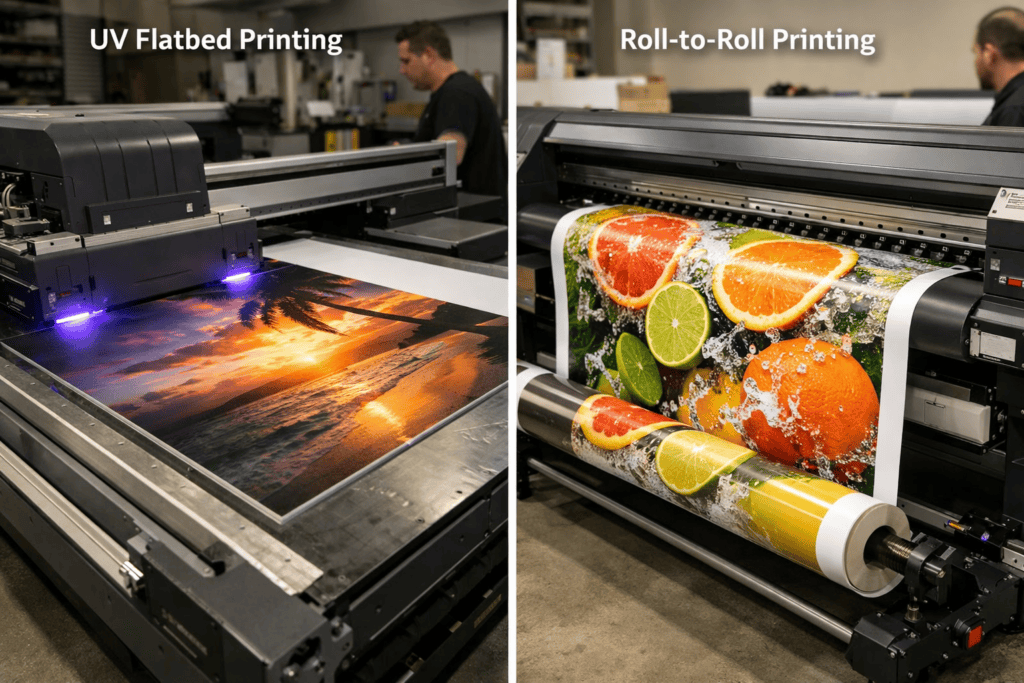
A UV flatbed printer has a large, flat vacuum bed onto which the substrate is placed. The print head traverses across the bed, depositing UV-curable ink directly onto the material surface. Immediately behind the print head, a UV lamp (typically LED-based on modern machines) cures the ink polymerising it from liquid to solid in a fraction of a second.
This instant curing is the defining characteristic. Because the ink is solid the moment it hits the substrate, there is no drying time, no risk of smearing during handling, and minimal ink absorption into the material. The print sits on the surface rather than soaking in, which produces vibrant colours on non-absorbent substrates and allows printing on materials that would be impossible with solvent or aqueous inks glass, metal, tile, leather, wood and pre-finished panels.
Modern flatbed machines accept substrates up to 3.2 metres by 2 metres (on the largest platforms) and up to 50mm thick. Thinner materials like vinyl sheets, paper and card are held flat by the vacuum bed. Thicker and heavier items aluminium composite panels, timber boards, acrylic blocks are loaded by hand or with a lifting crane depending on the machine specification.
How Roll-to-Roll Printing Works
Roll-to-roll printers feed flexible media from an input roll, print onto it as it passes through the machine, and wind the finished print onto an output roll. The technology handles any material that can be supplied on a roll: self-adhesive vinyl, PVC banner, polyester fabric, mesh, canvas, wallcovering, backlit film and paper.
The ink systems vary. Solvent and eco-solvent inks are common for vinyl and banner applications the solvent carrier penetrates the vinyl surface, bonding the pigment into the material for excellent durability without lamination. Latex inks offer similar versatility with lower VOC emissions and are increasingly common on newer machines. Dye-sublimation inks are used for polyester fabric printing, where the ink is transferred from a carrier paper into the fabric fibres under heat and pressure.
Roll-to-roll machines are built for throughput. A modern machine running at production speed can output 40-80 square metres per hour on vinyl and significantly more on lower-resolution banner work. This makes roll-to-roll the economical choice for any job involving large volumes of flexible media.
Print Quality Comparison
Both technologies produce commercially excellent output, but there are differences worth understanding. UV flatbed ink sits on the substrate surface, creating a slightly raised texture that is visible on close inspection and perceptible to touch. This can be a feature (it adds a tactile quality to premium displays) or a drawback (it may not suit photographic reproduction where a perfectly smooth finish is required).
Roll-to-roll solvent and latex prints have a smoother surface finish because the ink absorbs partially into the vinyl. Photographic work, skin tones and fine gradients tend to reproduce more naturally on roll-to-roll. Dye-sublimation fabric prints have the smoothest finish of all, as the ink becomes part of the fabric structure rather than sitting on it.
Resolution capabilities are broadly similar 1200 dpi is standard on both platforms but perceived sharpness depends on the substrate as much as the printer. A 720 dpi print on smooth cast vinyl will appear sharper than a 1200 dpi print on textured foamex. For guidance on matching resolution to viewing distance, see our article on print resolution for large format.
Material Compatibility
This is where the decision often makes itself. If your project requires printing onto rigid materials foamex panels, dibond sheets, corrugated board, acrylic, MDF, aluminium you need a flatbed. Roll-to-roll cannot handle rigid substrates.
If your project involves flexible materials on rolls self-adhesive vinyl, PVC banner, fabric, mesh roll-to-roll is the natural choice. Flatbed can print on flexible sheet materials (vinyl cut to sheets, for example), but it is slower and less efficient than feeding the same material from a roll.
For a detailed breakdown of substrates and their applications, our print substrates guide covers the full range of materials we work with.
The hybrid scenario arises when a single project includes both rigid and flexible elements for example, POS display production where the freestanding unit is printed on corrugated board (flatbed) and the header graphic is printed on vinyl or fabric (roll-to-roll). In these cases, colour consistency across the two print systems is managed through matched ICC profiles.
Speed and Cost Considerations
Roll-to-roll is faster for volume flexible print. The continuous feed mechanism eliminates the load/unload cycle that slows flatbed production, and modern roll-to-roll machines achieve production speeds that flatbed cannot match on flexible media.
Flatbed is faster for short runs of rigid materials. Printing ten foamex panels on a flatbed is quicker and cheaper than laminating printed vinyl onto the same panels (which is the alternative if you only have roll-to-roll available). For single rigid items a one-off exhibition panel, a prototype POS unit, an architectural feature flatbed is typically the only practical option.
Cost per square metre is generally lower on roll-to-roll for flexible media runs above 20-30 square metres. Below that threshold, the setup and handling involved in both technologies means the difference is marginal. For rigid substrates, flatbed is the only direct-print option, so the cost comparison is flatbed print versus roll-to-roll print plus lamination onto the rigid material and flatbed almost always wins on both cost and quality.
Durability and Outdoor Performance
UV-cured inks are inherently UV-resistant (they have already been exposed to high-intensity UV light during curing) and produce a hard, scratch-resistant surface. Unlaminated UV flatbed prints perform well outdoors for two to three years in typical UK conditions. With a UV-protective laminate, outdoor life extends to five years or more.
Solvent and eco-solvent prints on vinyl are also durable outdoors, with unlaminated life of two to three years and laminated life of five to seven years. The solvent bonding into the vinyl surface provides good abrasion and water resistance.
Latex prints offer similar outdoor durability to eco-solvent but with better scratch resistance in the unlaminated state. Dye-sublimation fabric prints are not inherently weatherproof and are primarily intended for indoor and covered outdoor use.
For exhibition stand graphics, where the prints are used indoors and handled frequently during setup and teardown, dye-sublimation fabric is preferred for its washability and crease recovery. For permanent outdoor signage and vehicle graphics, UV flatbed or laminated solvent roll-to-roll are the appropriate choices.
When to Use Each Technology
Choose UV flatbed when: the substrate is rigid (foamex, dibond, corrugated, acrylic, wood, metal, glass); the run is short (one to fifty units); you need to print directly onto the finished material without lamination; the project involves mixed-substrate production where everything needs to match; or you need white ink printing onto transparent or coloured substrates.
Choose roll-to-roll when: the material is flexible and supplied on rolls (vinyl, banner, fabric, mesh); the run length justifies the efficiency of continuous feed; the project requires the smoothest possible print surface for photographic or skin-tone reproduction; or you need dye-sublimation output for fabric graphics.
Use both when: the project includes rigid display elements and flexible graphics that must colour-match; you are producing a campaign with POS units (flatbed) and wall/window vinyl (roll-to-roll); or the programme involves exhibition hardware (flatbed-printed panels) alongside fabric graphics (dye-sub roll-to-roll).
If you are not sure which technology suits your project, discuss your project requirements with us and we will recommend the best production approach.
Frequently Asked Questions
Can a UV flatbed print on vinyl?
Yes. UV flatbed can print on sheet vinyl, but it is less efficient than roll-to-roll for large volumes. The UV ink sits on the vinyl surface rather than absorbing in, which produces a slightly different finish compared to solvent roll-to-roll printing. For short runs or when the vinyl is being applied to a rigid panel, flatbed is a practical option.
Is roll-to-roll print quality worse than flatbed?
No. Both technologies produce commercially excellent results. Roll-to-roll often produces smoother, more natural photographic reproduction on flexible media because the ink absorbs into the substrate. Flatbed excels at vibrant spot colours and solid blocks on rigid materials. Quality differences are application-specific rather than one being universally better.
Which is cheaper for large orders?
Roll-to-roll is more cost-effective for large volumes of flexible media due to its higher throughput speed and continuous feed mechanism. For rigid substrates, flatbed is the only direct-print option and is inherently cost-effective because it eliminates the lamination step that would otherwise be required.
Can you match colours between flatbed and roll-to-roll output?
Yes, with calibrated ICC profiles for each machine and substrate combination. We routinely produce campaigns where rigid POS elements are printed on flatbed and flexible wall or window graphics are printed on roll-to-roll, with colour-matched output across both systems.
What is the maximum size for UV flatbed printing?
Our flatbed platform accepts substrates up to 3.2 metres by 2 metres and up to 50mm thick. Larger graphics are produced in panels and joined on-site, or printed on roll-to-roll if the material is flexible. For oversized rigid installations, we can advise on panelling strategies that minimise visible joins.
Does UV flatbed printing smell?
UV-cured prints have minimal odour because the ink is fully cured (polymerised) during printing. There is no residual solvent off-gassing. This makes UV flatbed output suitable for enclosed environments such as hospital interiors, food service areas and retail spaces where air quality is a concern.