Walk into any supermarket, pharmacy or high street retailer and you will see them: freestanding cardboard displays near the entrance, countertop units beside the till, branded dump bins in the seasonal aisle, semi-permanent acrylic fixtures in the cosmetics section. Point-of-sale displays are so embedded in the retail environment that most shoppers barely register them which is precisely the point. A well-designed POS unit integrates seamlessly with its surroundings while directing attention and driving purchase decisions at the moment that matters most.
As a POS display manufacturing service, we produce every type of retail display unit from short-run promotional stands to high-volume national campaign deployments. This guide explains the main POS display formats, what each is designed for, and how to choose the right type for your campaign.
Key takeaways
- POS displays fall into four broad categories: freestanding display units (FSDUs), counter display units (CDUs), dump bins, and semi-permanent or permanent fixtures
- The choice of display type is driven by product weight, retail environment, campaign duration, retailer compliance requirements and budget
- Corrugated board is the dominant material for temporary and short-term displays; foamex, acrylic and metal are used for longer-lifecycle units
- Structural engineering and load testing are essential for any display that will hold product a collapsed FSDU in-store is a safety risk and a brand disaster
- Retailer compliance varies significantly between chains; a display accepted by one retailer may be rejected by another based on size, material, assembly method or fire rating
- Prototyping before volume production catches structural weaknesses, assembly problems and visual issues that are invisible in a flat artwork file
Freestanding Display Units (FSDUs)
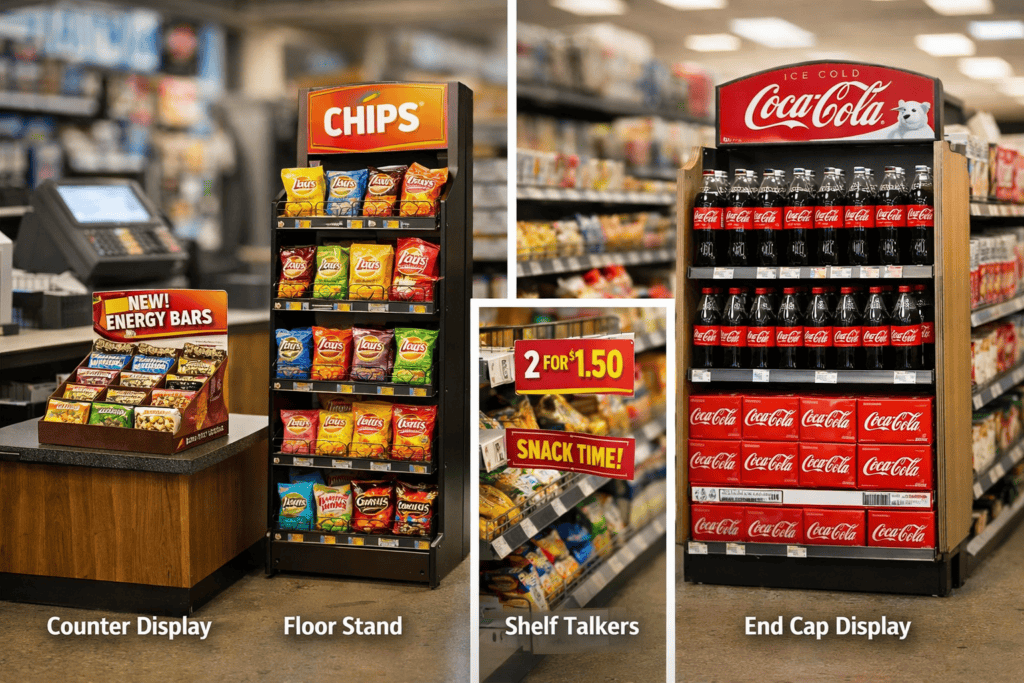
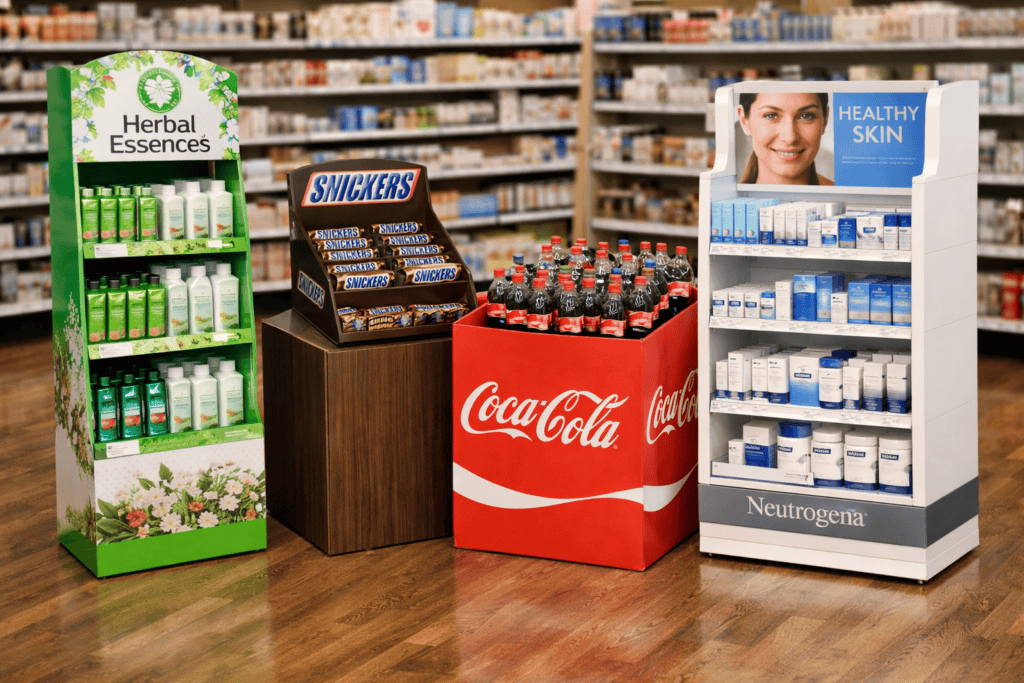
FSDUs are the largest and most visible category of POS display. They stand independently on the shop floor typically at aisle ends, near entrances, or in promotional zones and range in height from 1.2 metres to 1.8 metres. A well-positioned FSDU can increase product sales by 20-40% compared to standard shelf placement, which is why brands invest heavily in their design and deployment.
Standard FSDUs are constructed from printed corrugated board (typically B-flute or BC double-wall for strength) with die-cut shelves, header panels and kick plates. The structure is designed to ship flat-packed and assemble without tools usually via pre-scored folds, locking tabs and slot-together joints. Assembly time for a well-engineered FSDU should be under five minutes per unit.
The structural design must account for the weight of the product it will hold. A confectionery FSDU holding lightweight packets faces different engineering constraints to a drinks FSDU holding twelve glass bottles per shelf. Load testing both static (standing weight) and dynamic (the impact of products being added and removed repeatedly) should be completed during the prototyping phase, not discovered as a problem in-store.
Premium FSDUs use hybrid construction: a corrugated base structure with printed foamex or acrylic header panels, integrated LED lighting, and vacuum-formed product trays. These units cost more but deliver a significantly higher perceived quality that reflects well on the brand and justifies premium shelf positioning.
Counter Display Units (CDUs)
CDUs sit on retail counters, checkout desks, reception areas and tabletop surfaces. They are smaller than FSDUs (typically under 500mm tall) and are designed for impulse-purchase products, samples, leaflets, gift cards and small accessories.
The most common CDU format is a simple tray-style unit with a printed header card essentially an open-top box with a branded back panel. More complex CDUs include tiered shelving, rotating carousels, gravity-feed dispensers and integrated product dividers.
Because CDUs occupy valuable counter space, retailers are selective about what they accept. The unit must be compact enough to fit the available space, stable enough not to topple when a customer reaches for a product, and visually clean enough that the store manager does not remove it after the first day. Overengineered CDUs that dominate the counter or obstruct the transaction process are routinely rejected.
Dump Bins
Dump bins are open-top display containers designed for bulk, unstructured product display. The name is descriptive: products are “dumped” into the bin for customers to browse and select from. They work best for small, individually packaged products confectionery multipacks, seasonal items, discounted stock, sachets, small toys and promotional bundles.
The standard dump bin is a four-sided corrugated unit, approximately 600mm square and 1 metre tall, with a printed wrap around all four sides and a header panel. Some designs include an internal stepped platform that raises the product level as stock depletes, maintaining the appearance of a full display even when quantities reduce.
Dump bins are effective precisely because they create a sense of abundance and informality. Customers feel more comfortable picking through a dump bin than removing a carefully arranged product from a structured display. For promotional and clearance campaigns, this psychology drives higher engagement and faster sell-through.
Semi-Permanent and Permanent Display Units
Not all POS displays are disposable. Semi-permanent units (designed for three to twelve months) and permanent fixtures (designed for years of use) are constructed from more durable materials: foamex, acrylic, powder-coated metal, timber and injection-moulded plastic.
Semi-permanent displays are common in cosmetics, fragrance, electronics and premium FMCG categories where the brand presence needs to feel established rather than promotional. They typically feature modular construction (so that graphic panels can be updated without replacing the entire unit), integrated lighting, and high-quality surface finishes.
Permanent fixtures are engineered to the same standards as retail furniture. They are specified by material, weight capacity, fixing method and finish, and are often installed by specialist shopfitting teams rather than store staff. These units represent a significant investment and are typically justified by a long-term brand presence agreement with the retailer.
Materials: Corrugated Board, Foamex, Acrylic and Metal
The material choice determines cost, durability, print quality, weight and recyclability. For a detailed comparison, see our guide to choosing POS materials.
Corrugated board is the default for temporary displays. It is lightweight, fully recyclable, takes litho and digital print well, and can be die-cut into complex structural shapes. E-flute (1.5mm) and B-flute (3mm) are the most common grades; BC double-wall (6mm) provides additional rigidity for larger units.
Foamex (expanded PVC) is used for semi-permanent panels, header boards and small freestanding displays. It is waterproof, lightweight and easy to fabricate, but it is not recyclable through standard waste streams.
Acrylic is the material of choice for premium cosmetics and fragrance displays. It can be laser-cut, thermoformed, polished and printed, and it conveys a quality perception that corrugated and foamex cannot match.
Metal (typically mild steel with powder-coat finish) is used for permanent and heavy-duty semi-permanent displays where weight capacity and longevity are priorities.
Retailer Compliance and Specifications
Every major UK retailer has its own POS compliance standards, and they vary more than most brands expect. Some retailers specify maximum footprint dimensions, others mandate fire-rated materials, some require specific assembly methods (no adhesive tape, for example), and most have restrictions on display height and aisle placement.
Tesco, Sainsbury’s, Boots, WHSmith, Asda and the major fashion retailers all publish POS guidelines for their suppliers. Failing to meet these guidelines means your display will be rejected at the distribution centre or removed by the store team regardless of how much was spent on design and production.
We review retailer compliance requirements at the specification stage and flag any conflicts between the brand’s design intent and the retailer’s display policy before production begins. This prevents the expensive discovery that a fully produced and distributed display does not meet the retailer’s standards.
Prototyping and Testing: Why It Saves Money
A POS display that looks correct as a flat artwork file can fail completely in three dimensions. Shelves sag under product weight, header panels obscure the product they are meant to promote, locking tabs tear during assembly, and colour that appeared vibrant on screen looks flat on corrugated board.
We produce physical prototypes on the same materials and print processes as the final production run, so the sample is a genuine representation of what the finished unit will look, feel and perform like. The prototype is assembled, loaded with product (or product-weight equivalents), photographed in a representative retail setting, and assessed for structural integrity, assembly ease, visual impact and compliance with retailer specifications.
The prototype stage adds three to five days to the programme timeline. The cost is a small fraction of a volume production run. In our experience, prototyping catches problems on roughly 70% of new display designs problems that would have been far more expensive to discover after 5,000 units had been produced and distributed.
Deployment: Getting Displays Into Stores
Producing the display is only half the challenge. Getting it to the right store, at the right time, in the right condition, and assembled correctly is the other half and it is where many POS campaigns fail.
For national campaigns, we manage the complete deployment process: production, quality inspection, flat-packing, palletisation, distribution to individual store addresses or regional DCs, and (where required) in-store assembly by our field teams. Our fulfilment and distribution service handles the logistics, and for retail rollout programmes, POS deployment is coordinated alongside graphics and signage installation as a single integrated programme.
If you have a POS campaign to discuss, get a POS quote and we will advise on format, materials, compliance and deployment.
Frequently Asked Questions
What is the minimum order quantity for POS displays?
It depends on the display type and production method. Digitally printed corrugated displays can be produced economically from as few as 25 units. Litho-printed displays (which offer better colour consistency for large runs) typically become cost-effective from 250 units upward. Semi-permanent acrylic and metal displays are usually quoted per unit.
How long does it take to produce POS displays?
Allow three to four weeks from approved artwork to delivery for standard corrugated FSDUs and CDUs. Add one week if a prototype is required (recommended for new designs). Semi-permanent displays in acrylic or metal typically take four to six weeks depending on complexity.
Can you produce displays that comply with specific retailer requirements?
Yes. We hold compliance documentation for all major UK retailers and review display specifications against these requirements as standard. If your target retailer has specific guidelines, share them with us at the briefing stage and we will design to comply.
Do you offer assembly and installation in-store?
Yes. For national campaigns, we can deploy field teams to assemble and merchandise displays in-store. For self-assembly units, we include clearly illustrated assembly instructions and can provide video guides for store staff.
What happens to displays at the end of a campaign?
Corrugated displays are fully recyclable through standard cardboard waste streams. We can arrange collection and recycling of end-of-life displays as part of the campaign programme. Semi-permanent units can be stored in our warehouse for reuse in future campaigns.
Can you produce a prototype before we commit to a full run?
Yes, and we strongly recommend it. We produce prototypes on the same materials and print processes as the production run. The prototype is assembled, loaded and photographed so you can assess the unit before approving volume production.