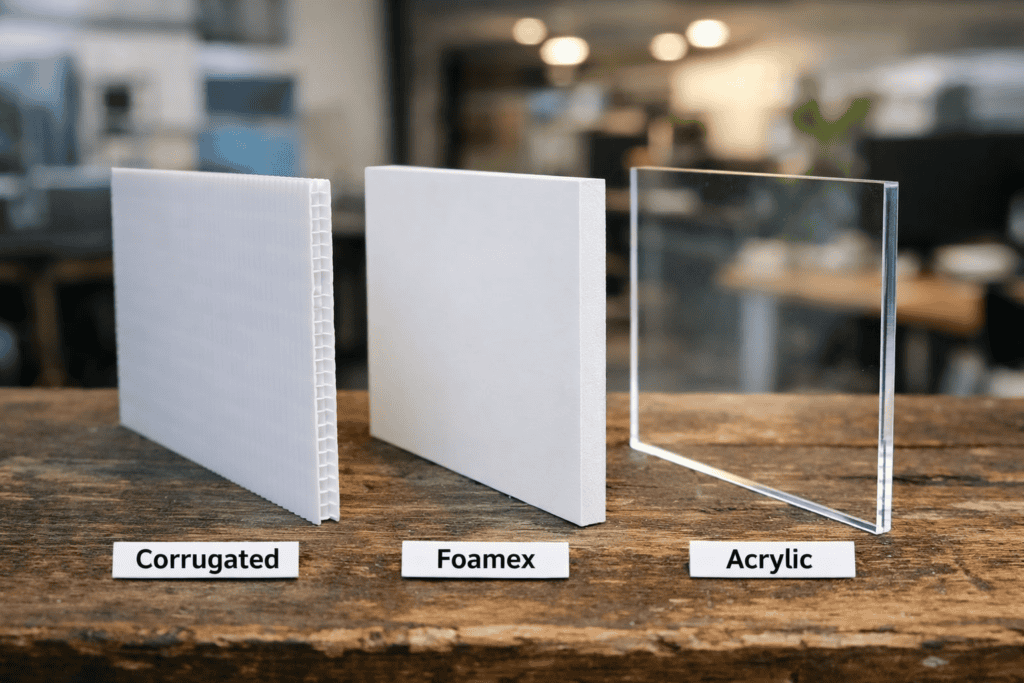
If you are specifying materials for point-of-sale displays, you will encounter three substrate options more than any others: corrugated board, foamex and acrylic. Each serves a different segment of the POS market, and the choice between them is driven by campaign duration, product weight, perceived quality requirements, retailer compliance standards and budget.
As a POS display manufacturer, we produce displays in all three materials and regularly advise clients on which is most appropriate for their specific campaign. This guide gives you the information to make that decision confidently.
Key takeaways
- Corrugated board is the default for temporary campaigns (one to twelve weeks), offering low cost, full recyclability and complex structural possibilities through die-cutting
- Foamex is the mid-range option for semi-permanent displays (three to twelve months), providing water resistance, reasonable rigidity and versatile fabrication
- Acrylic is the premium choice for permanent and semi-permanent displays, offering optical clarity, high perceived quality and the ability to integrate lighting effects
- Material choice affects not just cost and durability but also perceived brand quality a premium skincare brand on a corrugated display sends a different message than the same brand on polished acrylic
- Retailer compliance requirements may dictate or restrict material choices based on fire ratings, recyclability targets and waste handling policies
- Hybrid constructions (corrugated structure with acrylic or foamex feature panels) offer a balance of cost efficiency and visual quality
Corrugated Board: The Temporary Display Standard
Corrugated board dominates the temporary POS sector because it delivers three things simultaneously: low production cost, complex structural capability and full recyclability through standard cardboard waste streams.
The material consists of fluted paper sandwiched between two flat liner boards. Different flute grades produce different properties. E-flute (1.5mm) is thin and smooth, printing well on litho and digital flatbed systems with fine detail and photographic quality. B-flute (3mm) provides more rigidity and crush resistance, making it the standard for FSDU and CDU structures. BC double-wall (6mm) combines B and C flutes for maximum strength, used in dump bins and heavy-duty product displays. Triple-wall (up to 15mm) is specified for very heavy products and high-traffic environments.
The structural versatility of corrugated is its greatest advantage. Die-cutting allows complex three-dimensional forms shelves, trays, curved headers, interlocking joints, stepped platforms, hinged panels to be cut from flat sheets and assembled without adhesive or fasteners. A well-engineered corrugated display ships flat in a fraction of the assembled volume and assembles in under five minutes without tools.
The limitations are durability and environmental sensitivity. Corrugated board absorbs moisture, weakening the structure. In humid environments (chiller cabinets, store entrances during wet weather), uncoated corrugated displays soften and sag within days. Wax-coated or PE-coated corrugated extends moisture resistance but adds cost and may compromise recyclability. For displays expected to last beyond twelve weeks, or in environments with temperature or humidity variation, consider foamex or acrylic.
Foamex (Expanded PVC Foam Board)
Foamex is a closed-cell expanded PVC sheet material, available in thicknesses from 1mm to 19mm. It is lightweight (approximately half the density of solid PVC), rigid enough for freestanding display panels, waterproof, and prints well on UV flatbed systems. These properties make it the standard material for semi-permanent POS displays where corrugated board lacks durability but acrylic is unnecessarily expensive.
Standard applications include printed display panels, counter display units, information boards, A-frame inserts, and header panels for corrugated FSDUs where the header needs to be more rigid and durable than the corrugated structure it sits on. Foamex panels can be CNC-routed into shaped profiles, folded along score lines (for thinner sheets), and bonded with standard adhesives.
The surface texture of foamex is slightly grainy visible at close inspection but unnoticeable at typical display viewing distances (0.5-2 metres). For a smoother finish, the foamex can be printed on vinyl and face-mounted, or a high-density foam board variant can be specified (these have a finer cell structure that produces a smoother printing surface).
The environmental profile of foamex is its main drawback. PVC foam board is not recyclable through standard waste streams and is classified as commercial waste. For clients with sustainability commitments or retailers with packaging waste targets, corrugated board or the emerging range of recyclable foam board alternatives may be more appropriate. We can advise on the options available.
Acrylic (Perspex / Plexiglas)
Acrylic is the premium POS material. It is optically clear (92% light transmission better than glass), available in transparent, translucent, opaque, coloured and fluorescent variants, and can be fabricated into sophisticated display structures using laser cutting, CNC routing, thermoforming (heat bending), bonding and polishing.
In POS applications, acrylic is used for cosmetics and fragrance counter displays, jewellery display stands, technology product showcases, illuminated feature panels (acrylic transmits light evenly across its thickness through a phenomenon called light piping), and any display where the brand positioning demands a material that communicates premium quality.
Acrylic can be printed directly using UV flatbed technology, or printed on the reverse face for a glossy, protected finish where the print sits behind the acrylic surface. Reverse printing produces a depth and colour richness that surface printing cannot match, and the print is physically protected from scratches, fingerprints and cleaning damage by the acrylic itself.
The cost of acrylic displays is significantly higher than corrugated or foamex typically five to ten times the cost per unit for an equivalent structural design. This cost is justified for brands where the display quality directly supports the product positioning (luxury goods, premium cosmetics, high-end electronics) and for semi-permanent or permanent installations where the display will be in-store for twelve months or more.
Hybrid Constructions
Many effective POS displays combine materials to optimise the balance between cost, visual quality and structural performance. Common hybrid approaches include corrugated FSDU structures with acrylic header panels (the high-visual-impact header justifies the acrylic cost while the bulk of the structure uses economical corrugated), corrugated bases with foamex shelves (the shelves need to support product weight and resist moisture from chilled products, while the decorative outer panels can be standard corrugated), and metal or acrylic frameworks with interchangeable printed corrugated graphic panels (the permanent framework remains in-store while campaign-specific graphics are swapped out every few weeks).
Hybrid displays offer a practical middle ground for campaigns where full acrylic is too expensive but full corrugated does not project sufficient quality. They are particularly effective for semi-permanent brand bays where the structure stays but the product or message changes seasonally.
Retailer Compliance and Material Restrictions
Major UK retailers impose material requirements that may narrow your options. Sustainability-focused retailers may require all temporary POS to be 100% recyclable, effectively mandating corrugated board and excluding foamex. Fire-rated materials may be required for displays in certain store zones. Some retailers restrict the use of metal fixings (staples, screws) in corrugated displays due to potential product contamination in food retail environments.
Check retailer compliance requirements before finalising the material specification. We maintain compliance documentation for all major UK retailers and review material specifications against these requirements as part of every POS project.
Making the Decision: A Practical Framework
Campaign duration under 12 weeks, budget-sensitive, recyclability required: Corrugated board. Design for the structural requirements and accept the durability limitations.
Campaign duration 3-12 months, moderate budget, water resistance needed: Foamex. Suitable for displays in varied environments and robust enough for extended deployment.
Premium brand positioning, semi-permanent to permanent, budget allows: Acrylic. The material quality supports the brand and the longevity justifies the investment.
Mix of requirements within a single campaign: Hybrid. Use each material where its properties add most value.
For a multi-site rollout involving POS displays, material consistency across all sites is essential. We specify and document the material selection during the programme planning phase to ensure every unit across every location matches in construction, print quality and finish.
If you have a POS project and need material guidance, request a POS consultation and we will recommend the best material approach for your campaign objectives and budget.
Frequently Asked Questions
Is corrugated board strong enough for heavy products?
Yes, when correctly specified. BC double-wall and triple-wall corrugated can support significant product loads. The structural design (shelf depth, support ribs, load distribution) is as important as the board grade. We load-test prototypes with product-weight equivalents before committing to production.
Can foamex displays be recycled?
Standard foamex (PVC foam) is not recyclable through municipal or standard commercial waste streams. It must be disposed of as commercial waste. Recyclable foam board alternatives are emerging but are not yet widely available at equivalent cost and performance. We can advise on current options for clients with recyclability requirements.
Why is acrylic so much more expensive?
The raw material cost is higher than corrugated or foamex, and the fabrication process (laser cutting, polishing, thermoforming, bonding) is more labour-intensive and requires specialist equipment. Acrylic waste is also more expensive to manage. The premium is justified by the material’s optical quality, durability and the brand perception it creates.
Can you produce a prototype in each material for comparison?
Yes. We recommend this for new display designs, particularly when the material choice is not clear-cut. Seeing and handling prototypes in corrugated, foamex and acrylic side by side loaded with product makes the quality, weight and cost differences tangible and helps the brand team make an informed decision.
Which material is best for food retail environments?
Corrugated board is the standard for food retail POS due to its recyclability, compliance with most retailer policies, and absence of chemical contamination risks. Foamex and acrylic are acceptable in non-food zones but may require additional compliance documentation for use in food aisles. Always check the specific retailer’s guidelines.
Can displays be designed to switch between campaigns?
Yes. A permanent acrylic or metal framework with interchangeable printed panels (corrugated or foamex) allows the brand bay structure to remain in-store while the visual messaging changes seasonally. This is a cost-effective approach for brands with frequent campaign cycles.