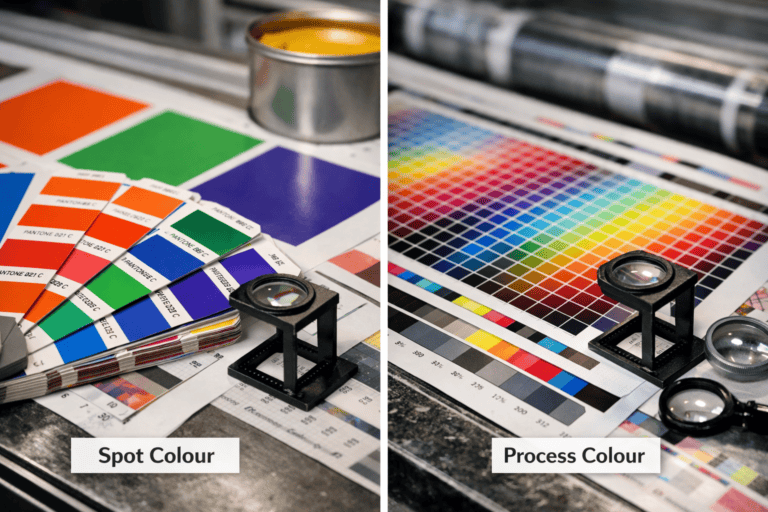
Spot colour uses a single pre-mixed ink in one pass. Process colour builds each shade from four overlapping inks: cyan, magenta, yellow, and black. The choice affects colour accuracy, production cost, and how consistently a brand appears across different materials and print runs. This article examines how each method works, where each performs best, and how to decide which suits a given brand project.
Key takeaways
- Confirm Pantone and CMYK values before briefing any printer. This helps avoid inconsistent output.
- Spot colour uses pre-mixed ink and bypasses CMYK dot-gain errors across different substrates.
- Process colour suits photography, gradients, and multi-colour artwork better than spot colour.
- Each additional Pantone ink needs its own mixing run and plate, which raises costs significantly.
- Logos, wordmarks, and packaging benefit most from a Pantone reference rather than a CMYK approximation.
- Pantone 485 C prints as a saturated red on coated stock but appears duller on uncoated.
- Store Pantone coated, Pantone uncoated, CMYK, RGB, and hex values in one master colour document.
What Spot and Process Colour Actually Mean in Print Production
| Factor | Spot colour | Process colour |
|---|---|---|
| How colour is made | Single pre-mixed ink specified through Pantone Matching System | Built from cyan, magenta, yellow and black halftone dots |
| Best for | Brand-critical marks that must stay consistent across suppliers | Photography, gradients and artwork with multiple colours |
| Consistency risk | More reliable regardless of paper stock or press calibration | Can shift with ink density, screen ruling and substrate |
| Recommended briefing | Supply Pantone reference | Supply validated CMYK build alongside Pantone reference |
Confirm your brand’s primary colour values in both Pantone and CMYK before you brief any printer. If those references are missing, production teams can mix to the wrong standard, and the error can spread across every touchpoint.
Spot colour uses a single pre-mixed ink specified through the Pantone Matching System. The printer applies that exact ink directly, which keeps output consistent regardless of paper stock or press calibration. That makes it the most reliable choice for brand marks that must stay consistent across suppliers.
Process colour builds every shade from cyan, magenta, yellow, and black printed in overlapping halftone dots. It handles photography and gradients well, but final colour can shift with ink density, screen ruling, and substrate. A deep navy in CMYK can print warmer or cooler depending on the press.
For a national rollout that spans multiple suppliers, use spot colour for brand-critical elements. If process printing is unavoidable, supply a validated CMYK build alongside the Pantone reference so each supplier works to a measurable target.
How Each Method Handles Colour Consistency Across Materials
Spot colour delivers consistent results across substrates — coated stock, uncoated card, fabric, and foil — because the ink is pre-mixed and bypasses the four-layer CMYK build entirely. This removes dot-gain error and reduces ink-density drift between runs. Pantone references make this cross-substrate match reliable where CMYK cannot.
Process colour works best for artwork with photographs, complex gradients, or more than three colours, where mixing individual spot inks would cost more than the print run justifies. CMYK output still varies between presses and paper coatings, so an approved colour proof signed off before each production run helps keep drift within an acceptable range.
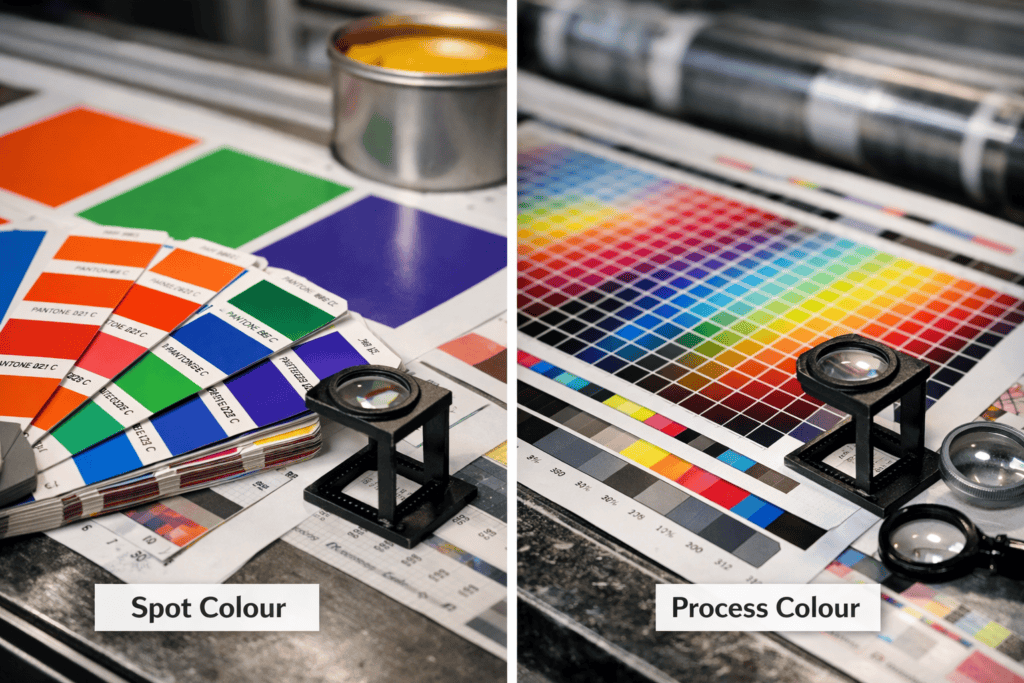
Hybrid jobs combine both methods — a Pantone ink for a brand logo alongside CMYK for editorial photography on the same sheet. Confirm that your printer supports both ink systems simultaneously. Not all configurations do, and the additional plate can affect unit pricing.
Cost, Volume, and Format: Choosing the Right Method for the Job
- Delivers stronger consistency for brand-critical elements
- Works well on screen printing, hot-foil stamping and pad printing where CMYK is not reliable
- Useful for single- or two-colour brand marks and non-white substrates
- Supports hybrid jobs where a logo needs Pantone accuracy alongside CMYK imagery
- Each additional Pantone ink needs its own mixing run and plate
- Becomes expensive on low-volume jobs or designs using more than two inks
- Not every press configuration supports spot and CMYK together
- Extra spot channels can add a press surcharge
Spot colour gets expensive on low-volume jobs or designs that use more than two inks. Each additional Pantone needs its own mixing run and plate, so a four-colour brand identity in pure spot costs significantly more than the same job in CMYK. For short runs — packaging proofs or limited-edition pieces — that cost per unit rarely justifies the consistency gain.
Process colour removes much of that cost disadvantage at scale. Once a CMYK press is profiled, extra copies add almost no setup cost. That makes it the practical choice for brochures, catalogues, and direct-mail campaigns with photographs and gradients throughout.
The print format also sets hard limits. Screen printing, hot-foil stamping, and pad printing cannot reproduce CMYK dot patterns reliably, so spot ink is the only option on those substrates. Digital offset and wide-format inkjet handle CMYK natively, and a spot channel is possible but carries a press surcharge. Confirm which colour modes your press supports before artwork is finalised, so you avoid late-stage file rebuilds.
Where Spot Colour Belongs in Brand Identity Work
Spot colour works best for logos, wordmarks, and brand icons that must match a brand standard exactly. Stationery, signage, and packaging benefit from a Pantone reference instead of a CMYK approximation.
When briefing a printer, include the Pantone Matching System reference with the CMYK and RGB values, and specify coated or uncoated stock. Pantone 485 C prints as a saturated red on coated paper but looks duller on uncoated stock. The correct suffix removes that ambiguity before plates are made.
Spot colour also suits single- or two-colour brand marks, foil-finished pieces, and jobs on non-white substrates. Fabric and screen-printed items rely on pre-mixed inks to hold colour across runs, since accurate colour print matching depends on controlling the ink itself.
The most common error is specifying a Pantone reference in a document that also contains process-colour photography. Most printers default to CMYK for the whole job unless the brief explicitly requests an additional ink station. If the brand mark must stay spot while photography runs in CMYK, state that clearly in the print specification and confirm press setup before production begins.
Building a Colour Strategy That Works Across Print and Screen
Colour strategy breaks down when RGB, CMYK, and Pantone references sit in separate specs instead of one coordinated system. A hex-only brand colour can shift when a supplier converts it to CMYK without a reference point. It can then shift again when another supplier interprets that CMYK differently.
Keep a master colour document that records every version of each brand colour: Pantone coated, Pantone uncoated, CMYK, RGB, and hex. Send it with every print brief. Spot colour keeps physical collateral consistent across formats where CMYK cannot. Process colour suits mixed-media campaigns that include photography without the added plate cost.
Specialist outputs such as fan deck production often use both methods within a single project — spot colour on the deck cover, process colour for photographic content inside. Commercial Print Services handles both and can advise on the right approach before production begins.
Frequently Asked Questions
What is the difference between spot colour and process colour in brand work?
Spot colour prints with a single pre-mixed ink in one pass. Process colour builds each shade from four inks — cyan, magenta, yellow, and black. Spot colour gives precise, consistent hues that are critical for brand logos. Process colour works well for photography and complex gradients, but it cannot guarantee exact Pantone matches across print runs.
When should a brand use spot colour instead of process colour?
Spot colour guarantees exact colour reproduction, regardless of print run length or substrate. Use it for brand-critical elements such as logos, packaging, and branded stationery, where consistency across suppliers and print methods cannot rely on CMYK interpretation. It can also reduce costs on short runs and single- or two-colour jobs compared with full process printing.
Why do some brand colours print more accurately as spot colours?
Choose spot colour when a brand needs an exact, repeatable shade. Process colour creates hues by layering cyan, magenta, yellow, and black dots. The final result can shift with ink density, paper stock, and press calibration. Spot inks are pre-mixed to a fixed formula, which removes those variables entirely.
How do cost, run length, and print method affect the choice between spot and process colour?
Short runs that need exact brand colours suit spot printing. It uses fewer plates, gives predictable ink matching, and keeps per-unit costs lower at low volumes. Process colour is more economical on longer runs or for photographic content, where four-plate setups spread across thousands of units. Digital printing removes plate costs entirely, so it stays practical for short, variable jobs regardless of colour method.
Can spot colour and process colour be used together in the same branded print project?
Using both systems in one print job is common, especially for brand packaging and annual reports. A document might use CMYK for photography and reserve a Pantone spot colour for the logo. Most commercial presses support this as a five- or six-colour run, though each additional ink raises cost and requires careful file setup for correct separation.