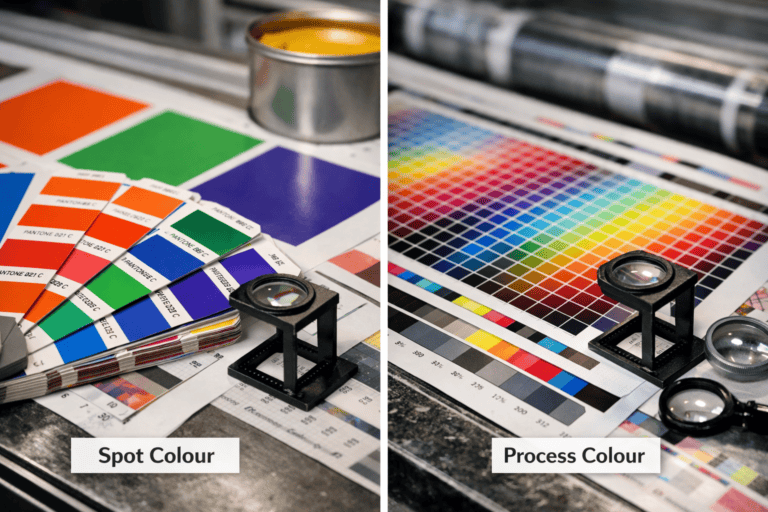
A fan deck is a deceptively complex product. It looks like a simple collection of colour swatches bound together with a rivet, but producing one that is accurate enough to sell paint by involves colour science, specialist printing, precise substrate selection, rigorous quality control and a production workflow that most commercial printers are not equipped to handle.
We produce fan decks and colour sampling tools for paint manufacturers, coatings companies and colour system providers through our colour sampling and specialist print service. This guide explains the production process from initial colour measurement through to finished product, and what makes the difference between a fan deck that represents colours accurately and one that does not.
Key takeaways
- Fan deck production starts with spectrophotometer measurement of every colour in the range against a physical master reference not a digital file
- Each colour is printed using a custom ICC profile built for the specific substrate, ink system and printing conditions used in production
- Substrate selection is critical the base paper or card determines colour appearance, texture, opacity, flexibility and how closely the swatch represents the actual painted surface
- Quality control is per-colour, not per-batch every colour in every production run is measured against the master and must fall within the agreed Delta E tolerance
- Finishing processes (die-cutting, collating, riveting, shrink-wrapping) must handle printed stock without scratching, scuffing or contaminating the colour surface
- Fan decks are replenishment products stock management and reprint consistency across batches are as important as first-run accuracy
Step 1: Master Colour Measurement
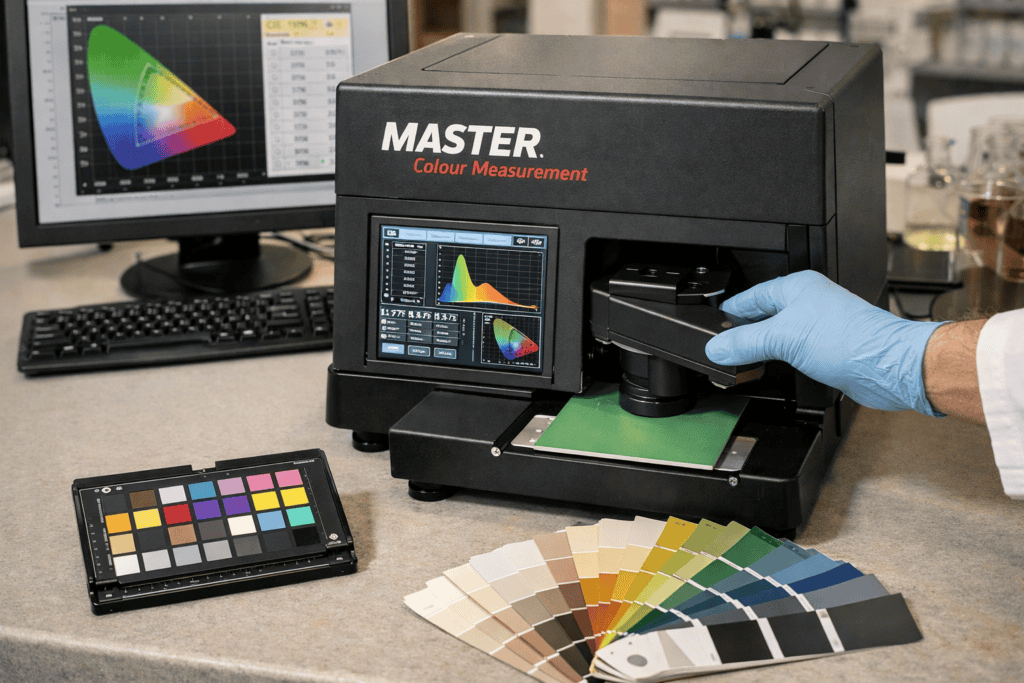
Every fan deck project begins with a set of master colour references. These may be physical painted samples, existing swatch cards from a previous production run, or wet paint samples that we draw down and measure. The master reference for each colour is measured using a spectrophotometer under controlled conditions (typically D50 illuminant, 2° observer, 45°/0° geometry) and the spectral data is recorded as the production target.
This measurement data not a Pantone number, not a CMYK recipe, not a hex code is what drives the colour matching. A Pantone reference can get you into the general vicinity of a colour, but it cannot account for the substrate, ink system and printing conditions that determine the final appearance. Spectral measurement captures the full colour information and allows the ICC profiling software to calculate the exact ink combination needed to reproduce that colour on the production substrate.
For new colour ranges, we recommend that the client provides physical painted samples on the surface type most representative of the end application (for example, painted card for an interior paint range, or coated metal for an industrial coatings range). This allows us to optimise the print reproduction to match the colour as it will appear in its intended context.

Step 2: Substrate Selection
The substrate (paper or card) used for fan deck swatches has a measurable impact on colour accuracy and perceived quality. Key substrate properties include base whiteness (which affects the brightness and saturation of printed colours), surface texture (which affects how the colour is perceived under directional lighting), opacity (which determines whether underlying colours or text show through), and weight and flexibility (which affects how the fan deck handles).
Most fan deck substrates are coated art papers or cards in the 200-350gsm range. The coating provides a consistent, smooth surface for ink reception and prevents ink absorption variability that would cause colour inconsistency across the swatch. Uncoated substrates produce a softer, more textured appearance but with less precise colour control acceptable for some applications but not for premium paint colour systems where the swatch must be a reliable purchasing guide.
Some clients specify substrates that simulate the finish of the painted surface for instance, a slightly textured card for a matt emulsion range, or a high-gloss coated card for a gloss paint range. This enhances the customer experience (the swatch feels similar to the painted wall) but introduces additional complexity in colour matching because the paint colour matching process must account for the optical effects of the substrate texture and gloss level.
Step 3: ICC Profile Building
An ICC profile is a mathematical model that describes the relationship between the colour data sent to a printer and the colour that appears on the substrate. For fan deck production, a custom ICC profile is built for the specific combination of printer, ink set and substrate being used. This is not a generic profile it is a profile built from a measured test chart printed on the actual production substrate under actual production conditions.
The profiling process involves printing a standardised colour chart (typically 1,000-3,000 colour patches), measuring every patch with a spectrophotometer, and feeding the measurement data into profiling software that calculates the mathematical relationship between input values and output colours. The resulting ICC profile is then used to convert the target spectral data for each fan deck colour into the precise ink combination that will reproduce it on this substrate, on this printer, under these conditions.
Profile accuracy is verified by printing a verification chart and measuring it against predicted values. A good profile will produce a maximum Delta E of under 2.0 and an average Delta E of under 1.0 across the verification patches. If the profile does not meet this standard, the profiling process is repeated with adjustments to linearisation, ink limits or black generation.
Step 4: Colour Proofing
Before committing to a full production run, a proofing stage allows the client to assess colour accuracy on the production substrate. We print every colour in the range on the actual production paper, at the actual production print resolution, using the production ICC profile. Each proof swatch is measured against the master spectral data and the Delta E is recorded.
The proof deck is sent to the client alongside a measurement report showing the Delta E for every colour. Colours that fall outside the agreed tolerance (typically ΔE2000 ≤ 2.0 for standard ranges, ≤ 1.0 for premium ranges) are flagged for review. The client can approve, request adjustment, or accept a wider tolerance for specific problematic colours (some colours particularly very dark shades and highly saturated oranges are inherently difficult to reproduce in CMYK print and may require tolerance relaxation).
Step 5: Production Printing
Production runs for fan decks are managed with batch controls that exceed standard commercial print practice. Each production batch is printed under controlled conditions consistent ink density, consistent substrate feed, consistent curing temperature and sample swatches are pulled at regular intervals and measured against the master references.
If any colour drifts outside tolerance during the run, production is paused, the issue is diagnosed (ink density drift, substrate variation, environmental change), and corrections are applied before resuming. This inline quality control is resource-intensive but necessary a colour error discovered after the entire run has been printed means reprinting the entire run.
For large colour ranges (200-500+ colours), production is typically scheduled across multiple print sessions to maintain consistent quality. The ICC profile and calibration data ensure colour consistency between sessions, and reference strips from each session are retained for traceability.
Step 6: Finishing and Assembly
Once printed, the swatch sheets move into finishing: die-cutting to the final swatch shape, collating into colour sequence, drilling the rivet hole, binding with a metal or plastic rivet, and packaging. Each of these steps carries a risk of damaging the printed surface a scuff, scratch or fingerprint on a colour swatch renders it useless as a colour reference.
Die-cutting must produce clean, burr-free edges without compressing the printed surface. Collating must follow the exact colour sequence specified by the client’s colour system. Riveting must be tight enough to hold the swatches securely but loose enough to allow the fan to spread smoothly. And the finished product must be packaged in protective shrink-wrap or a rigid case to prevent transit damage.
For clients requiring warehousing and replenishment, finished fan decks are stored in our facility and dispatched against orders. Stock management includes batch tracking (so that any colour accuracy query can be traced back to the specific production run) and replenishment triggers when stock drops below a defined minimum.
Step 7: Reprint Consistency
Fan decks are replenishment products. A paint manufacturer’s colour range may remain in market for three to ten years, with fan decks reprinted periodically as stock depletes. The challenge is ensuring that a fan deck printed in 2028 matches one printed in 2026 because a decorator using a replacement fan deck to match a colour specified from an earlier edition must be selecting the same colour.
Reprint consistency depends on maintaining the ICC profile, calibration data, substrate specification and master reference data from the original production run. We archive all production data for every fan deck project and re-verify the ICC profile against the master references before each reprint run. If the substrate specification has changed (even a minor change in paper batch whiteness), the profile is adjusted or rebuilt to compensate.
If you have a colour sampling or fan deck project to discuss, start a sampling project with us and we will advise on production approach, substrates and colour tolerance specifications.
Frequently Asked Questions
How many colours can a fan deck contain?
There is no practical upper limit. We produce fan decks ranging from 50-colour specialist ranges to 2,000+ colour comprehensive systems. The production process is the same regardless of size every colour is individually profiled, printed and measured. Larger ranges are split across multiple fan decks or produced as colour cards rather than fan format depending on the client’s preference.
What Delta E tolerance should I specify for fan deck production?
For standard paint colour ranges, a ΔE2000 of 2.0 or below is the industry norm. Premium ranges and colour systems used as primary purchasing references typically target ΔE2000 of 1.0-1.5. Some colours (very dark shades, highly saturated oranges and reds) are inherently harder to reproduce in CMYK and may require wider tolerances for specific swatches.
Can you match our existing fan deck from a competitor producer?
Yes. We measure the existing fan deck using our spectrophotometer to establish master references, then build the production profile from those measurements. This approach reproduces the actual colours rather than relying on nominal colour references that may not match the original production exactly.
How long does fan deck production take?
Allow four to six weeks from approved proof to delivery for a standard colour range (up to 200 colours). Larger ranges (500+ colours) may require six to eight weeks. The proofing stage adds one to two weeks. Rush production is available for urgent requirements at additional cost.
Can you produce individual swatch cards instead of fan decks?
Yes. We produce loose swatch cards, peel-and-stick colour chips, colour charts, colour cards and paint-out cards in addition to traditional fan decks. The colour management and production process is the same the only difference is the finishing format.
What file format do you need for the colour data?
Ideally, spectral measurement data in a standard format (CxF, MIF, or CSV with L*a*b* values and measurement conditions). Physical samples are equally acceptable we measure them in-house. Pantone or RAL references are a starting point but not sufficient for colour-critical reproduction. Digital files (CMYK or RGB values) are the least reliable and we recommend against relying on them for fan deck production.