Sustainability has moved from a nice-to-have to a procurement requirement for many organisations commissioning print. NHS Trusts, local authorities, publicly listed companies and B-Corp certified businesses are all increasingly required to demonstrate that their supply chain including print production meets specific environmental standards. But navigating the sustainability claims around print materials is not straightforward. Some claims are meaningful. Others are marketing. Knowing the difference helps you specify genuinely lower-impact materials without paying for greenwashing.
We supply sustainable material options across large format print, signage and POS display production. This guide covers what is currently available, what the certifications mean, and where the genuine environmental gains are in commercial print.
Key takeaways
- PVC-free alternatives now exist for many large format applications but they do not yet match PVC for cost, durability and versatility in every scenario
- Corrugated board remains the most genuinely sustainable POS material: fully recyclable through standard waste streams, produced from renewable fibre, and increasingly available from FSC-certified sources
- Dye-sublimation fabric printing uses water-based inks with no VOC emissions and produces polyester graphics that are recyclable through textile recycling programmes
- FSC chain-of-custody certification for paper and board substrates is the most widely recognised and meaningful sustainability credential in print
- Ink technology is a significant factor: latex and UV-curable inks have lower environmental impact than solvent-based inks during production
- The biggest sustainability gain in most print programmes comes from specifying the right material for the intended lifespan overengineering (using permanent materials for temporary applications) generates unnecessary waste
PVC and the Alternatives
PVC (polyvinyl chloride) is the dominant material in large format print self-adhesive vinyl, PVC banner, foamex panels and rigid PVC sheet are all PVC-based. PVC’s environmental concerns centre on chlorine chemistry in production, plasticiser additives (phthalates), difficulty of recycling, and the release of hydrogen chloride if incinerated. These are legitimate concerns, and they have driven the development of PVC-free alternatives.
PVC-free self-adhesive films (based on polypropylene, polyester or polyurethane) are available from major manufacturers including 3M, Avery Dennison and Hexis. They print and apply similarly to standard vinyl and are suitable for most interior applications. For exterior use, PVC-free films are improving but do not yet match the durability and conformability of cast PVC vinyl in all applications particularly vehicle wraps and complex curved surfaces.
PVC-free banner materials (polyester-based or woven polyethylene) replace standard PVC banner for event and exhibition use. They are lighter, recyclable through textile or plastic streams, and do not contain phthalate plasticisers. The trade-off is typically higher cost (20-40% premium) and reduced weather resistance compared to heavy-duty PVC banner.
For rigid substrates, alternatives to foamex include recycled-content foam boards, paper-based honeycomb panels, and aluminium composite (which, while not bio-based, is fully recyclable through metal recycling streams and has an indefinite material lifespan).
Corrugated Board: The Sustainable Default for Temporary Displays
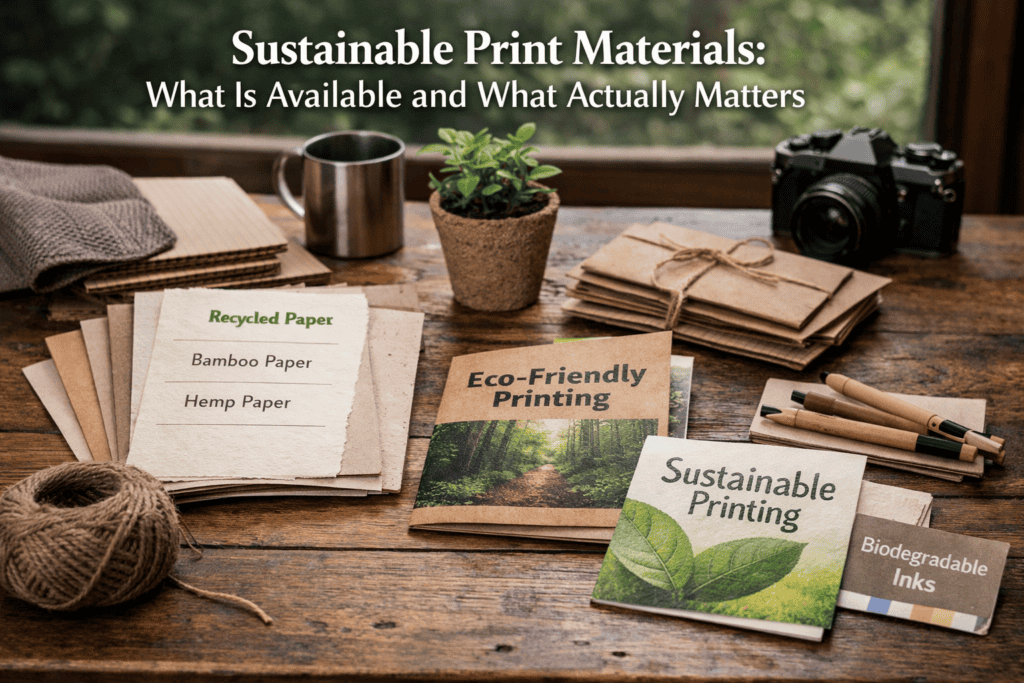
If your project involves temporary POS displays or short-term promotional graphics, corrugated board is the most environmentally responsible choice by a significant margin. It is produced from renewable wood fibre (often with high recycled content), it is fully recyclable through standard cardboard waste streams (which are well-established and efficient in the UK), and it biodegrades if it enters the environment.
FSC (Forest Stewardship Council) chain-of-custody certification is available for corrugated board, providing auditable evidence that the fibre source was responsibly managed. For organisations with sustainability reporting requirements, FSC-certified corrugated POS is the simplest route to a defensible environmental claim.
The limitation of corrugated is durability it is not waterproof, it weakens in humid environments, and it is not suitable for long-term use. For applications where the display lifespan exceeds twelve weeks, see our comparison of POS material options.
Fabric: Lightweight, Washable, Recyclable
Dye-sublimation printed polyester fabric is a strong sustainability option for exhibition and event graphics. The inks are water-based (no solvents, no VOC emissions during printing), the fabric is recyclable through polyester textile recycling programmes, and the lightweight material reduces transport emissions compared to heavy PVC alternatives.
The reusability of fabric further improves its environmental profile. A dye-sublimation fabric graphic that is used for 20 exhibitions over three years displaces the production and disposal of 20 separate single-use PVC banners. The cumulative material saving is significant.
Fabric is not a universal replacement for PVC it is not waterproof, it is not self-adhesive, and it cannot be applied to surfaces like vinyl. But for backdrops, banners, tension frames and portable displays, it is both the higher-quality and the lower-impact option.
Ink Systems and Their Environmental Impact
The ink used in large format print has a measurable environmental footprint that varies significantly between technologies.
Solvent and eco-solvent inks use organic solvents as the carrier, which evaporate during and after printing (VOC emissions). Eco-solvent formulations have lower VOC content than traditional solvent inks but still emit volatile compounds. Solvent prints have an odour that dissipates over 24-48 hours relevant for interior installations in sensitive environments.
Latex inks are water-based with polymer binders that fuse onto the substrate under heat. They produce minimal VOC emissions, no detectable odour, and are GREENGUARD Gold certified for use in sensitive environments including schools and healthcare facilities. Latex is our preferred ink system for interior graphics and applications where indoor air quality matters.
UV-curable inks are polymerised by ultraviolet light and produce virtually zero VOC emissions because the ink converts from liquid to solid without any evaporation. UV prints are odourless and suitable for food-contact-adjacent applications. The environmental consideration is energy consumption UV curing lamps use significant power, though LED-UV systems are substantially more efficient than older mercury-lamp systems.
Dye-sublimation inks are water-based and produce no VOC emissions. The heat-transfer process uses energy but produces no liquid waste. Dye-sub is the cleanest ink technology currently available for large format production.
Waste Reduction: Specifying for Lifespan
The most significant sustainability improvement in many print programmes is not switching materials it is specifying materials appropriate to the intended lifespan. Using seven-year cast vinyl for a three-month campaign generates unnecessary material cost and eventual waste. Using three-month economy vinyl for a three-month campaign matches the material to the application and reduces both cost and environmental impact.
For multi-site rollout programmes with defined campaign durations, we specify materials matched to the campaign timeline. This approach reduces cost, simplifies end-of-life waste management, and prevents the common problem of over-specified permanent materials remaining in situ long after the campaign has ended because nobody has budgeted for removal.
Certifications and Standards Worth Knowing
FSC (Forest Stewardship Council): Chain-of-custody certification for paper and board products, verifying responsible forestry sourcing. The most widely recognised and credible certification for print substrates.
GREENGUARD / GREENGUARD Gold: Certification for low chemical emissions from printed products and interior finishes. Relevant for graphics installed in schools, healthcare facilities and offices with indoor air quality requirements.
ISO 14001: Environmental management system certification. Indicates that the print provider operates a structured environmental management system it does not certify specific products but demonstrates organisational commitment to environmental management.
Carbon balancing / carbon offsetting: Programmes that offset the carbon emissions associated with print production. The credibility varies significantly between schemes look for verified offsets (Gold Standard or VCS certified) rather than unverified claims.
If you have specific sustainability requirements for a print project, discuss your environmental specifications and we will recommend materials and processes that meet your requirements with evidence.
Frequently Asked Questions
Can you produce completely PVC-free large format print?
For many applications, yes. PVC-free films, polyester fabric, corrugated board, paper-based substrates and aluminium composite cover the majority of large format requirements. Some specialist applications (vehicle wraps, long-term exterior graphics on complex surfaces) still benefit from PVC-based materials where the alternatives do not yet match performance. We advise on a case-by-case basis.
Is recycled material available for large format print?
Recycled-content corrugated board is widely available and performs identically to virgin board for most POS applications. Recycled-content foam boards and paper stocks are available from specialist suppliers. Recycled-content vinyl films are emerging but not yet mainstream. We source recycled-content materials where they are available and meet the performance requirements of the application.
How do we dispose of print waste responsibly?
Corrugated board: standard cardboard recycling. Vinyl and PVC: commercial waste stream (some specialist recycling programmes exist but are not widely accessible). Fabric: textile recycling. Aluminium composite: metal recycling. We can include end-of-life waste management recommendations in the project specification and arrange collection and recycling for multi-site programmes.
Does sustainable print cost more?
Sometimes. PVC-free films carry a 20-40% material premium over standard PVC vinyl. FSC-certified board is typically cost-neutral. Fabric graphics cost similarly to PVC equivalents. The largest cost saving often comes from specifying materials matched to the intended lifespan rather than over-specifying permanent materials for temporary applications.
Can you provide environmental data for sustainability reporting?
Yes. We can provide material data sheets, FSC certificates, GREENGUARD certifications, ink safety data sheets and estimated carbon footprint data for specific projects. For organisations with formal ESG reporting requirements, we compile the environmental data package as part of the project documentation.
What is the single most impactful sustainability change in print?
Matching material specification to intended lifespan. Eliminating the use of permanent, hard-to-recycle materials for temporary applications removes more waste from the system than any single material substitution. After that, switching from PVC to corrugated board for temporary POS and from PVC banner to fabric for exhibition graphics deliver the largest material-level improvements.