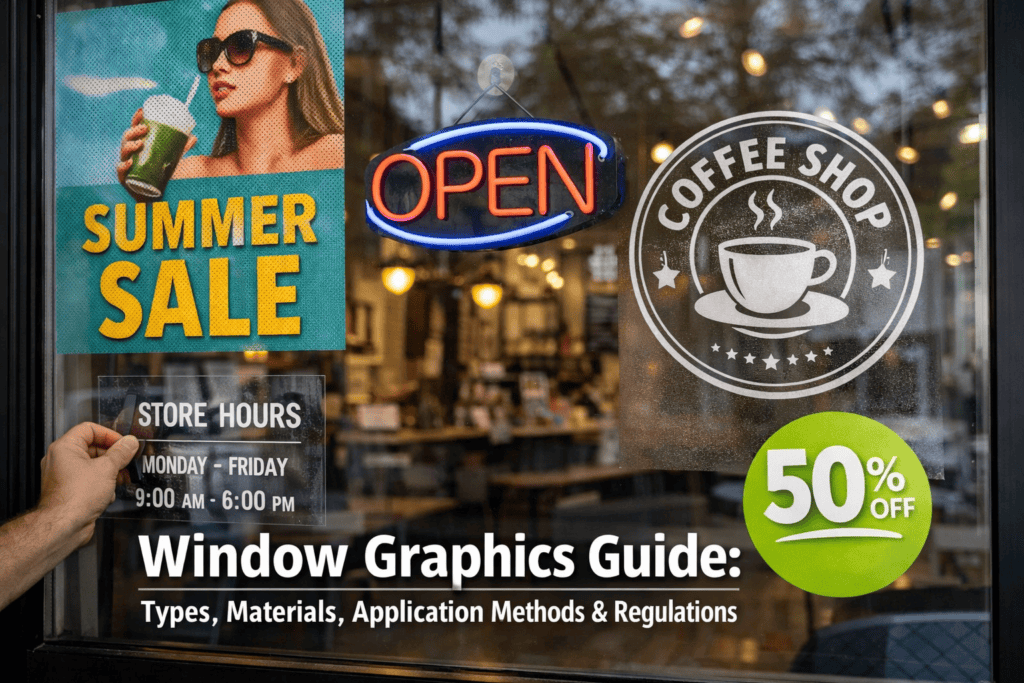
Window graphics serve dual purposes that few other print applications manage simultaneously: they communicate outward to attract attention from passers-by, and they modify the interior environment by controlling light, privacy and brand atmosphere. A well-specified window graphic programme can transform a blank glass frontage into a brand statement, a privacy screen, a promotional display and an architectural feature often all at once.
We produce window graphics across the full range of formats and materials as part of our large format print service, from single-unit shop windows to multi-site retail rollouts covering hundreds of locations.
Key takeaways
- Window graphic types include full-coverage vinyl, cut vinyl lettering, etched glass film, one-way vision (perforated) vinyl, manifestation graphics and printed window cling
- Application surface (first, second or third surface) determines whether the graphic is applied inside or outside and affects durability, appearance and removal
- One-way vision vinyl allows a printed graphic visible from outside while maintaining outward visibility from inside ideal for retail frontages where interior light must be preserved
- Manifestation graphics (decorative banding or patterns) are a legal requirement on full-height glass in many commercial buildings to prevent collision injuries
- Landlord and planning restrictions frequently apply to window graphics in retail settings check before production, not after installation
- Seasonal and promotional window campaigns benefit from window cling or low-tack vinyl that removes cleanly without adhesive residue
Window Graphic Types and Applications
Full-coverage printed vinyl covers the entire glass pane with a printed image, blocking light and view in both directions. This is used for brand wraps, privacy screening, construction hoarding on glazed facades, and situations where the window is non-functional (display windows with no interior behind them, screened building services, blank elevations). Digitally printed self-adhesive vinyl is applied to the inside face (second surface) for protection from weather and vandalism, or to the outside face (first surface) for specific visual effects.
Cut vinyl lettering and graphics are solid-colour vinyl shapes cut to precise letter or logo profiles on a computer-controlled cutting plotter. The vinyl is transferred to the glass using application tape. Cut vinyl produces clean, sharp edges with a professional finish that printed vinyl cannot quite match for simple text and logo applications. Colours are specified from manufacturer swatch books (such as 3M, Avery or Oracal ranges) to ensure exact colour matching.
Etched glass effect film simulates the appearance of acid-etched or sandblasted glass. It is a translucent, slightly textured film that diffuses light while maintaining brightness. It is used for privacy (meeting rooms, medical facilities, bathroom screens) and for branding (logos and patterns cut from etched film create an elegant, understated brand presence). Custom-printed translucent films extend this concept to full-colour frosted effects.
One-way vision vinyl (also called perforated vinyl or contra-vision) is a printed vinyl with thousands of small perforations (typically 1-1.5mm holes at 50% density). From outside, the printed graphic is visible the eye reads the printed surface because the perforations are too small to see individually at typical viewing distance. From inside, the view through the window is maintained because the eye focuses through the perforations to the scene beyond. The result is a window that functions as a printed graphic externally and a transparent window internally.
One-way vision works best in conditions where the exterior is brighter than the interior daylight viewing from outside, with the darker shop interior behind the glass. At night, when interior lighting is brighter than the exterior, the effect reverses and the graphic becomes more visible from inside. This is a physics limitation of the material, not a defect.
First Surface, Second Surface and Third Surface
Window graphic terminology uses “surface” numbering to describe where the graphic is applied. First surface is the exterior face of the glass (outside, exposed to weather). Second surface is the interior face of the glass (inside, protected from weather). Third surface applies to double-glazed units the exterior face of the inner pane.
Second surface application is the default for most commercial window graphics. The glass protects the print from rain, UV exposure, vandalism and physical contact, extending the graphic lifespan significantly. The print is produced in reverse (mirror image) so that it reads correctly when viewed through the glass from outside.
First surface application is used when second surface is not accessible (sealed double-glazed units where the cavity prevents access to second surface), when the visual effect requires the graphic to sit proud of the glass (creating shadow and dimension), or for temporary applications where easy removal from outside is needed.
Manifestation: A Legal Requirement
Building Regulations Approved Document K (Protection from Falling, Collision and Impact) requires that full-height glazing in commercial buildings includes manifestation visible markings that indicate the presence of the glass to prevent people walking into it. The manifestation must be visible in all lighting conditions and must be positioned at two heights: between 850mm and 1000mm, and between 1400mm and 1600mm above floor level.
Manifestation graphics can be functional (simple horizontal bands or dots) or decorative (branded patterns, frosted panels, gradient effects). This is an opportunity to turn a regulatory requirement into a design feature. Well-designed manifestation integrates with the brand aesthetic while fulfilling the safety function. Etched glass film is the most common material for manifestation because it is durable, cleanly finished and available in a range of opacities.
Seasonal and Promotional Window Campaigns
Retail window campaigns change frequently monthly, seasonally, or for specific promotional events. For short-duration campaigns, the material must remove cleanly and quickly to minimise changeover time and avoid residue on the glass.
Window cling (static cling vinyl) adheres to glass without adhesive, using electrostatic charge. It applies and removes instantly, leaves zero residue, and can be repositioned during installation. The print quality and colour vibrancy of cling is slightly lower than adhesive vinyl, and it does not adhere reliably to textured or non-glass surfaces, but for flat glass windows with frequent graphic changes, cling is the most practical material.
Low-tack adhesive vinyl offers better adhesion than cling (more reliable on imperfect glass surfaces) while still removing cleanly for up to six months. Beyond six months, even low-tack adhesive begins to cure and removal becomes more difficult. For seasonal retail programmes with quarterly window changes, low-tack is a reliable compromise between adhesion and removability.
Planning and Landlord Restrictions
Window graphics in commercial properties are frequently subject to restrictions that are not obvious until someone objects. Landlord lease terms may restrict the percentage of window coverage, the colours used, or the types of material permitted. Shopping centre management teams typically require approval of window graphics before installation, with restrictions on coverage, branding density and the use of promotional pricing in window displays.
In conservation areas, even temporary window graphics may require advertisement consent from the local planning authority. The rules are inconsistent between authorities some treat window vinyl as an advertisement requiring consent, while others consider it part of the shopfront display and exempt from control. For multi-site programmes, each location must be assessed individually.
Installation and Removal
Professional window graphic installation requires clean glass (any contamination creates bubbles and adhesion failure), correct ambient temperature (most adhesive vinyls require application above 10°C cold glass on a January morning may need preheating with a heat gun), and skilled application technique. Large panes (above 2 metres) are best installed by two-person teams to manage the graphic size and prevent creasing.
Removal of permanent vinyl that has been in place for more than six months requires a heat gun or steamer to soften the adhesive, followed by slow peeling at a shallow angle to minimise residue. Remaining adhesive is cleaned with a citrus-based solvent. Well-managed removal leaves the glass in its original condition.
If you have a window graphics project, get a window graphics quote and we will advise on materials, application method and any planning restrictions.
Frequently Asked Questions
Can you print on the inside of a window and have it visible from outside?
Yes. This is second surface application the graphic is printed in reverse and applied to the inside face of the glass. Viewed from outside through the glass, the image reads correctly. This is the standard approach for most commercial window graphics because the glass protects the print from weather and vandalism.
Does one-way vision vinyl reduce light inside the shop?
Yes. One-way vision vinyl typically reduces light transmission by 40-60% depending on the perforation ratio. This is noticeable in smaller or deeper retail units. For shops that rely on natural light, consider partial-height one-way vision (lower section only) with clear glass above, or supplementing with interior lighting adjustments.
How long do window graphics last?
Interior-applied (second surface) vinyl graphics typically last five to seven years on glass. Exterior-applied (first surface) graphics last two to four years depending on exposure. Etched glass film lasts ten years or more. Window cling and low-tack vinyl are designed for short-term use up to twelve months maximum.
Do I need planning permission for window graphics?
It depends on the location. In most standard commercial areas, window vinyl does not require advertisement consent. In conservation areas, Areas of Outstanding Natural Beauty, and some managed retail estates, consent may be required. Check with the local planning authority before installation, particularly for permanent or large-scale window treatments.
Can window graphics be applied to double glazing?
Yes, but only to the first surface (exterior face of the outer pane) or the fourth surface (interior face of the inner pane). Applying vinyl to the second or third surface (inside the sealed unit) is not possible without breaking the seal, which would void the unit’s warranty and thermal performance. Standard second-surface application to the interior face of the inner pane works well for most applications.
What about window graphics on curved or textured glass?
Curved glass requires a conformable vinyl with the flexibility to follow the curvature without lifting at the edges. Textured glass (patterned, reeded, sandblasted) is generally unsuitable for adhesive vinyl application because the texture prevents full adhesive contact. Etched film adheres more successfully to lightly textured surfaces. Heavily textured glass may require alternative approaches such as external panel mounting.