Vehicle graphics turn every delivery van, service vehicle and fleet car into a mobile advertisement that works twenty-four hours a day without a media budget. A liveried vehicle generates between 30,000 and 70,000 visual impressions per day in urban environments, making it one of the lowest cost-per-impression marketing channels available to any business with wheels on the road.
We produce vehicle graphics from simple door lettering to full vehicle wraps as part of our large format print service, for individual vehicles through to commercial fleet programmes covering hundreds of units.
Key takeaways
- Vehicle graphic options range from simple cut vinyl lettering (lowest cost, most durable) through partial wraps and printed panels to full vehicle wraps (highest impact, highest cost)
- Cast vinyl is essential for full wraps and any application over complex curves, recesses and rivets calendered vinyl shrinks and lifts on vehicle bodywork
- Vehicle wraps do not damage factory paintwork when properly applied and removed they protect the paint underneath from UV and minor abrasion
- A full wrap on a standard panel van costs approximately £1,500-£3,000 depending on complexity, with a usable lifespan of five to seven years
- Fleet livery programmes require colour consistency across vehicles and production batches managed through ICC profiling and batch reference controls
- Vehicle wraps can be removed and replaced without repainting, making them ideal for leased vehicles and rebranding programmes
Cut Vinyl Lettering and Logos
The simplest and most durable form of vehicle graphic is cut vinyl solid-colour vinyl cut to letter or logo shapes on a computer-controlled plotter and applied directly to the vehicle bodywork. There is no printed element; the colour is the vinyl itself, which means it will not fade, crack or delaminate for the full lifespan of the material (seven to ten years for premium cast vinyl).
Cut vinyl is specified from manufacturer colour charts (3M, Avery Dennison, Oracal, Hexis) and is available in hundreds of solid colours, metallics, fluorescents and special effects. It is the correct choice for company name, telephone number, website, logo and simple graphic elements where the design does not require photographic images or complex colour gradients.
The cost is significantly lower than printed graphics because there is no print production involved only cutting, weeding (removing the waste vinyl around the cut shapes) and application. A standard panel van with company name, contact details and logo in cut vinyl typically costs £200-£500.
Digitally Printed Vehicle Graphics
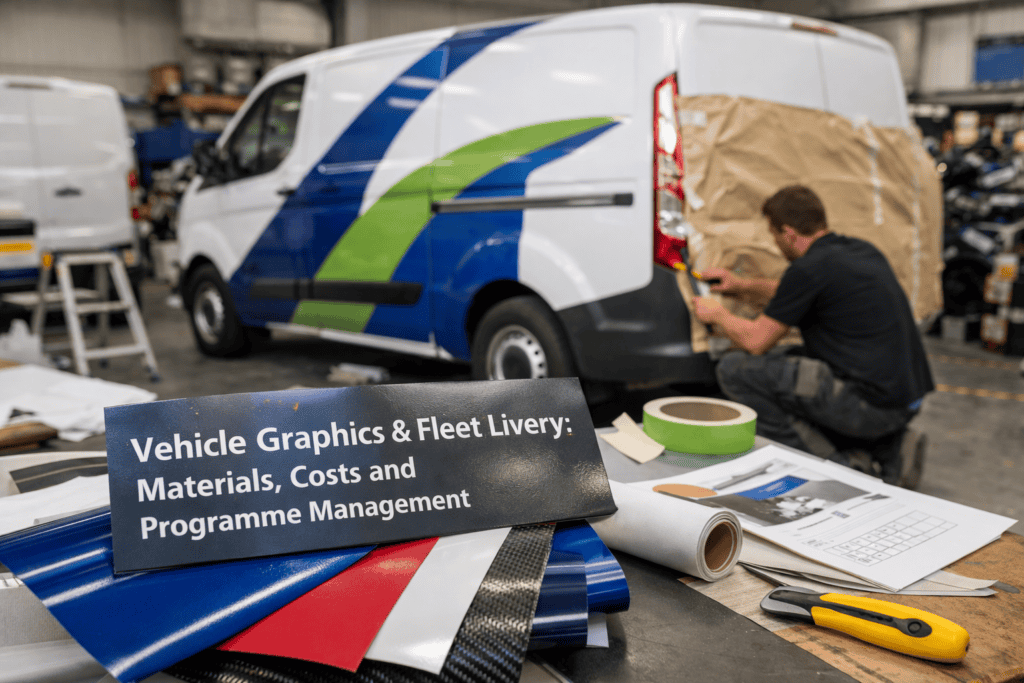
When the design requires photographic images, colour gradients, complex illustrations or full-colour brand livery, digitally printed vinyl is used. The artwork is printed onto white or clear self-adhesive vinyl using wide-format inkjet, then over-laminated with a clear protective film that provides UV resistance, scratch protection and a consistent surface finish (gloss, satin or matt).
Printed vehicle graphics can be applied as panels (covering specific areas doors, rear panels, bonnet), as a partial wrap (covering significant areas while leaving some painted bodywork visible), or as a full wrap (covering every visible surface including bumpers, mirrors and handles).
The vinyl specification is critical. Cast vinyl (50 microns, highly conformable, rated for 7-10 years) is required for any application over compound curves, body styling features, recesses and corrugated surfaces. Calendered vinyl (80-100 microns, less conformable, rated for 3-5 years) is adequate for flat and gently curved panels but will shrink and lift on complex surfaces within months.
Full Vehicle Wraps
A full vehicle wrap covers every visible surface with printed vinyl, transforming the vehicle’s appearance entirely. The vehicle can become a completely different colour, carry full-bleed photographic imagery, or display brand livery that would be impossible to achieve with paint alone.
Wrapping is a skilled process. The vinyl is heated with a heat gun to make it conformable, stretched over curved surfaces, pressed into recesses and channels, and trimmed around edges, handles, lights and other fixtures. A standard panel van takes one to two days to wrap; a complex vehicle (car with extensive body styling, or a bus with multiple panels and apertures) may take three to four days.
Wraps protect the original paintwork underneath. When the wrap is removed (typically at the end of its lifespan or when the vehicle is returned to a lease company), the paint beneath is in the condition it was in when the wrap was applied protected from UV fading, stone chips and minor scratches. This is a significant advantage for leased vehicles, where maintaining paintwork condition affects residual value.
Full wrap costs vary by vehicle size and design complexity. A standard panel van full wrap is typically £1,500-£3,000. A car wrap is £1,200-£2,500. A 40-foot articulated trailer is £2,000-£4,000. These costs include design adaptation (fitting the artwork to the specific vehicle template), printing, lamination and application.
Fleet Programmes
For multi-vehicle fleet programmes, consistency across vehicles is essential. Vehicle 1 liveried in January must match Vehicle 50 liveried in December. Colour drift between production batches a common problem in large format print is managed through ICC profiling, daily press calibration, and retention of printed reference strips from each batch.
Fleet programme logistics follow the same principles as multi-site rollout programmes: standardised vehicle templates for each model in the fleet, site-specific (vehicle-specific) artwork adjusted for vehicle variants within the same model range, warehousing of pre-printed kits for vehicles entering the fleet on a rolling basis, and a documented application standard that every installer follows regardless of location.
For large fleets, we hold printed livery kits in stock and dispatch them as new vehicles are acquired or existing vehicles are due for livery replacement. This avoids the delays associated with initiating a new print run for every individual vehicle.
Design Considerations for Vehicle Graphics
Vehicle graphic design differs from static graphic design in several important ways. The graphic is viewed in motion typically at speeds of 20-40 mph in urban environments so the message must be readable in two to three seconds. This means large, high-contrast text, simple imagery and minimal information. A phone number, website and three-word description of what the business does is more effective than a paragraph of text that nobody can read.
The vehicle shape is part of the design surface. Wheel arches, body lines, window apertures, handles and panel joints all interrupt the graphic. Effective vehicle livery works with these features rather than ignoring them using body lines as compositional elements and placing key information on the largest uninterrupted panels (rear doors, side panels above the wheel arch).
Vehicle templates (accurate line drawings of the vehicle showing all panels, apertures and features) are essential for design and pre-press. We maintain a library of templates for common commercial vehicle models and can survey specific vehicles for bespoke template creation.
Removal and Replacement
Vehicle graphics are designed to be removable. Cast vinyl with an appropriate adhesive (typically a grey pressure-sensitive adhesive with air-release channels) can be removed cleanly from factory paintwork within the material’s rated lifespan. Removal involves heating the vinyl to soften the adhesive, peeling at a controlled angle, and cleaning any adhesive residue with a citrus-based solvent or isopropyl alcohol.
Removal difficulty increases with age. Vinyl applied for less than three years removes easily. Vinyl in place for five to seven years requires more heat and patience. Vinyl left beyond its rated lifespan (eight to ten years for cast) may require professional removal to avoid paint damage. If you know the vehicle will be rebranded or returned to a lease company at a specific date, plan the removal in advance rather than leaving the vinyl to deteriorate.
If you have a vehicle livery or fleet programme to discuss, get a vehicle graphics quote and we will advise on materials, design approach and programme logistics.
Frequently Asked Questions
Will vehicle graphics damage my paintwork?
No. Properly applied cast vinyl protects the paint underneath from UV, stone chips and minor abrasion. When removed within the rated lifespan (seven to ten years), the paint beneath is typically in better condition than exposed panels. The only risk is to paintwork that was in poor condition before application flaking, poorly keyed or non-factory paint may lift when the vinyl is removed.
How long does a vehicle wrap last?
Cast vinyl wraps have a rated outdoor lifespan of five to seven years in UK conditions. With a protective over-laminate, this extends to seven to ten years. The first sign of ageing is typically edge lifting on the most exposed panels (bonnet, roof), which can be repaired locally without replacing the entire wrap.
Can I wrap a leased vehicle?
Yes. Vehicle wraps are routinely applied to leased vehicles. The wrap protects the paintwork and removes cleanly, returning the vehicle to its original colour. Most lease companies accept wraps provided they are applied and removed professionally. Check your specific lease agreement for any restrictions.
How long does it take to wrap a vehicle?
A standard panel van full wrap takes one to two days. A car wrap takes one to two days. Partial wraps and cut vinyl lettering take half a day to one day depending on complexity. The vehicle must be clean and dry before application, and ideally garaged overnight after application to allow the adhesive to bond fully.
Can you match our brand colours exactly on vehicle vinyl?
For printed graphics, yes we colour-manage vehicle vinyl production to the same standards as all our large format output. For cut vinyl, we match to the closest available colour from the manufacturer’s range. If the brand colour does not have an exact match in the vinyl range, printed vinyl in the exact brand colour is the alternative.
Do you provide vehicle templates for design?
Yes. We maintain templates for common commercial vehicles and can create bespoke templates from a vehicle survey. Templates are supplied as scaled vector drawings showing all panels, apertures, handles and features, ready for the design team to work with.